Spitfire Mk.Ia (Late)
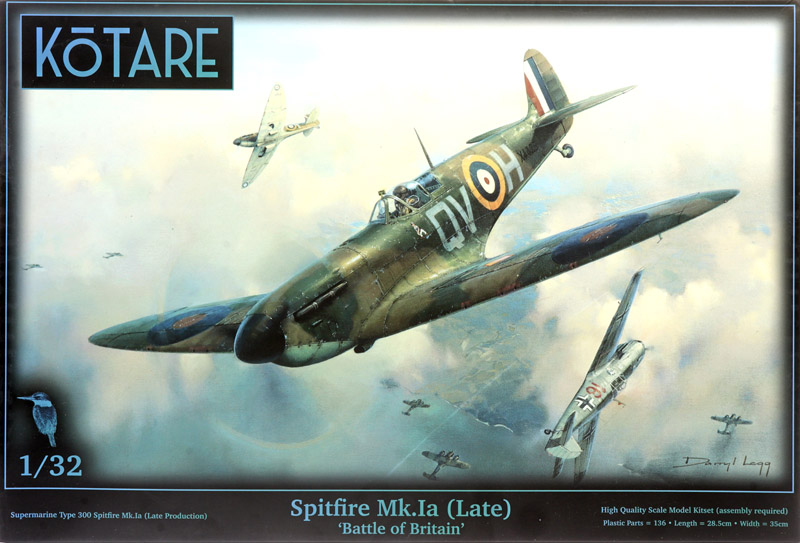
Kotare Models, 1/32 scale
S
u m m a r y : |
Description and Item No.: |
Kotare Models Kit No. K32005 - Spitfire Mk.Ia (Late) |
Contents and Media: |
116 parts in grey coloured plastic (nine parts marked not for use); nine parts in clear (with four not used); decals with three marking options; comprehensive instructions in an A4-sized 32 page book. |
Price: |
USD$109.00 plus shipping available online from Kotare Models' webstore |
Scale: |
1/32 |
Review Type: |
First Look |
Advantages: |
Clever parts breakdown; manageable number of parts; beautifully detailed; perfectly moulded; authentic surface textures; comprehensive instructions and notes; high quality Cartograf decals. |
Disadvantages: |
None noted. |
Recommendation: |
Kotare's latest release is less about new tooling than it is about historical refinement. Their original Spitfire Mk.I established a benchmark for engineering and accuracy, while this edition captures the mature Battle of Britain fighter that incorporated the lessons of the first year of the Second World War.
The arrangement of sprues reflect important production changes that distinguished late Mk.Is from their earlier counterparts. For anyone wishing to build what many regard as the definitive Battle of Britain Spitfire, Kotare has delivered an exceptionally well-researched and beautifully executed kit.
Kotare does not subscribe to the idea that every new release demands a pile of new plastic. Instead, they are using an already outstanding kit as a platform to tell different historical stories.
This release isn't exciting because it has dozens of new sprues—it doesn’t. It is exciting because it accurately depicts a very specific and critical point in the Spitfire's evolution.
We have seen this same approach with their earlier PR. Type A and Brian Lane boxings.
I can’t wait to see the next Chapter! |
Reviewed by Brett Green

When the prototype Supermarine Spitfire first took to the air on 5 March 1936, it immediately demonstrated the exceptional performance that would make it one of history's most celebrated fighter aircraft. Conceived by the brilliant designer R.J. Mitchell as a modern monoplane interceptor, the Spitfire combined an advanced all-metal stressed-skin airframe with its distinctive elliptical wing and the powerful Rolls-Royce Merlin engine. Entering RAF service during the summer of 1938, the Spitfire Mk.I represented the cutting edge of fighter design, but like many successful wartime aircraft, it was continuously refined as operational experience exposed opportunities for improvement.
There was no official "late-production" Spitfire Mk.Ia. Instead, Supermarine introduced a steady stream of modifications throughout the Mk.I production run, incorporating engineering improvements and combat lessons as quickly as they became available. Aircraft rolling off the production line during the summer of 1940 differed in numerous respects from those delivered only a year earlier. The result was the definitive Battle of Britain Spitfire Mk.Ia—a fighter that represented the peak of the type's development before production transitioned to the Mk.II.
Power continued to come from the reliable 1,030 hp Rolls-Royce Merlin III, but one of the most significant improvements was the widespread adoption of constant-speed propellers. Early production Spitfires had been fitted with fixed-pitch or two-position propellers that limited acceleration and climb performance. By the time of the Battle of Britain, both de Havilland and Rotol constant-speed propellers had become common, automatically maintaining optimum engine revolutions throughout the flight envelope. The improvement in climb, acceleration and overall combat effectiveness was immediately appreciated by RAF pilots and proved invaluable during the intense aerial fighting over southern England.
Operational experience gained during the fighting over France in 1940 also led to significant improvements in pilot protection. Armour plating was installed behind the pilot's seat, while an external armoured windscreen became standard equipment on later production aircraft. The Sutton harness replaced earlier restraint systems, and many aircraft received improved radio equipment as the RAF transitioned from the TR.9D to the more capable TR.1133 high-frequency set. Identification Friend or Foe (IFF) Mk.II equipment was also progressively installed, helping Britain's increasingly sophisticated air defence system distinguish friendly fighters from enemy aircraft.
Numerous detail changes accompanied these more visible improvements. Metal-covered ailerons gradually replaced the original fabric-covered surfaces, improving roll response and durability, while revised cockpit instrumentation, alternative seat types, improved undercarriage controls and numerous smaller production refinements reflected the constant evolution of the design. None of these changes fundamentally altered Mitchell's original concept, but collectively they produced a more capable and survivable fighter.
The Spitfire's structure also reflected the realities of 1930s aircraft manufacture. To maximise aerodynamic efficiency, flush rivets on the wings and forward fuselage were filled and smoothed before painting, creating the remarkably clean surface finish for which the Spitfire became renowned. Removable access panels often displayed wider or slightly uneven joints than many modern modellers might expect, while subtle undulations in the stressed skin and lightly buckled panel edges were entirely characteristic of the real aircraft. These were not production defects but the natural result of lightweight stressed-skin construction and the hand-built nature of Supermarine's manufacturing process.
By the outbreak of the Battle of Britain in July 1940, the Spitfire Mk.Ia had matured into one of the world's finest fighters. Although fewer in number than the Hawker Hurricane, Spitfire squadrons formed the RAF's elite fighter force and were generally tasked with engaging the Luftwaffe's Messerschmitt Bf 109 E escorts while Hurricanes concentrated on the bomber formations. The Spitfire's superb manoeuvrability, harmonious controls and excellent high-speed handling made it a formidable opponent, while its eight wing-mounted .303 Browning machine guns delivered a dense volume of fire that proved effective against contemporary aircraft.
Its principal adversary, the Messerschmitt Bf 109 E, was every bit as modern and capable. Powered by the Daimler-Benz DB 601 with direct fuel injection, the German fighter could bunt into a negative-G dive without momentarily starving its engine of fuel—an advantage over the carburetted Merlin III. The Bf 109 E also possessed an outstanding rate of climb and excellent acceleration, while its automatic leading-edge slats enhanced manoeuvrability at the edge of the flight envelope. The Spitfire, however, generally enjoyed a tighter turning circle, lighter and more harmonious control forces, and exceptional agility throughout much of the combat envelope. In reality, the two fighters were remarkably well matched, with pilot skill, tactical positioning and fuel state often proving more decisive than the relatively small performance differences between them.
Throughout the Battle of Britain, late-production Spitfire Mk.Is equipped many of the RAF's most famous squadrons, including Nos. 19, 54, 66, 74, 92, 603 and others. Together with the Hurricane, they played a decisive role in denying the Luftwaffe air superiority over southern England. The failure of Germany's air campaign forced Adolf Hitler to postpone indefinitely the planned invasion of Britain, making the Spitfire an enduring symbol of one of the Second World War's most significant turning points.
Production of the Mk.I gradually gave way to the externally similar Mk.II during the autumn of 1940. The new variant introduced the Merlin XII engine, a Coffman cartridge starter and several minor refinements, but represented an evolutionary rather than revolutionary development. Within another year, however, the appearance of the formidable Focke-Wulf Fw 190 demanded a more substantial increase in performance, leading to the Merlin 45-powered Spitfire Mk.V and the next major chapter in the aircraft's remarkable development.
Today, the late-production Mk.Ia is widely regarded as the definitive Battle of Britain Spitfire. Combining the elegant lines of Mitchell's original design with the practical improvements born of operational experience, it represents the aircraft at the very moment it earned its legendary reputation. It is this mature and battle-hardened version that Kotare Models has chosen to reproduce in exquisite detail.
Kotare Models is the brainchild of modeller and veterinary specialist, Mark Robson.
Mark has put together a team with some names that will be familiar to Wingnut Wings fans including General Manager - Richard Alexander, Product Designer - Darren Mildenhall, Decal Artist - Malcolm Laird, Profile Artist – Ronny Bar and more.
The 2023 debut release for this venture was a 1/32 scale mid-production Spitfire Mk.Ia. Kotare’s definition of mid-production is in the N3XXX and P9XXX serial number range completed between September 1939 and April 1940. These could be distinguished by an improved cockpit door latch, a reflector gun sight, tapered aerial post and a voltage regulator behind the pilot’s head rest. Some mid-production Spitfires were fitted with a Rotol RX5/1 propeller and spinner, and a TR.1133 VHF radio that did not require an external aerial wire.
This kit, and a number of subsequent Kotare Spitfire releases, has now sold out so this new late production Spitfire Mk.Ia is very welcome.
What Defines This as Late Production
This model represents a late Mk.Ia in the R6595 to R7022 and X4009 to X4997 serial number ranges completed between May 1940 and January 1941.
The plastic in this release is mostly common to the original Mid Production kit.
Sprues A, C (clear), D and E are identical on both kits.
Sprue B has been modified slightly. The parts for the early / mid undercarriage hand pump and signalling switch box have been deleted.
Sprue G, originally seen in the Kotare Spitfire Mk.V kits, has been added to this release.
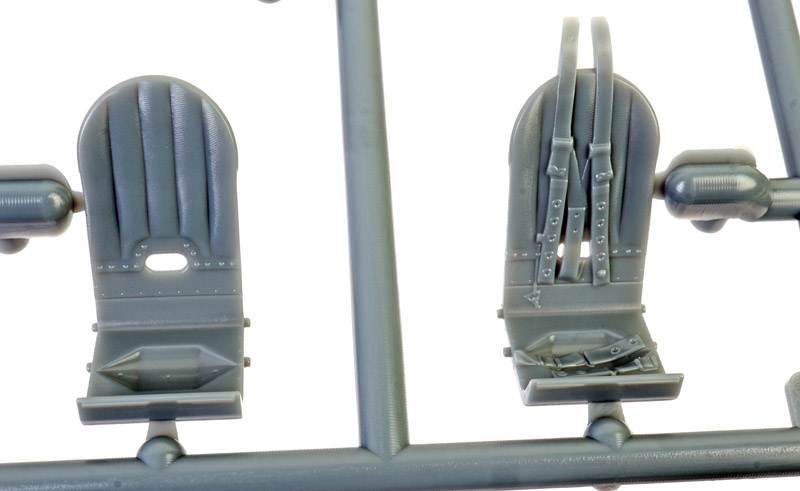
This offers the late-style composite seat, engine driven undercarriage control unit, IFF "pip squeak", and late style elevator trim tab wheel.
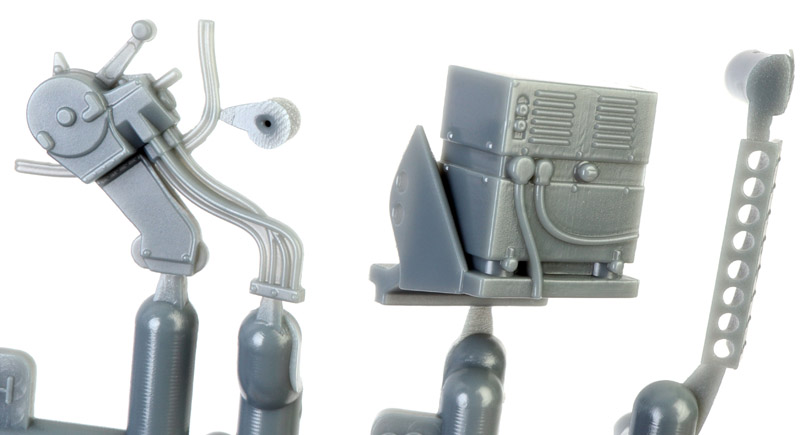
The kit parts (including options) that define this model as a Late Production version include:
- Rotol versus de Havilland constant-speed propellers.
- TR.9D and TR.1133 radio installations.
- IFF Mk.II equipment.
- Late composite seat and optional early metal seat.
- Open and closed canopy options.
- Armoured windscreen.
- Pilot's armour.
- Battle of Britain specific details.
Surface Textures
Kotare continues to resist the temptation to exaggerate surface features for visual effect. Instead, they have reproduced the distinctive manufacturing characteristics of the real Spitfire, including filled flush riveting over much of the wing and forward fuselage, subtly uneven removable panels and restrained skin undulations. These features may surprise modellers accustomed to perfectly symmetrical engraved panel lines, but period photographs confirm that they accurately capture the subtly irregular appearance of operational Spitfires.
Deep Dive into Kotare's Spitfire Mk.Ia
Kotare Models’ 1/32 scale Spitfire Mk.Ia (Late) comprises 116 parts in grey coloured plastic (including nine parts not used), nine parts in clear (with four not used), decals with three marking options and comprehensive instructions in an A4-sized 32 page book.
First, let’s talk about the number of parts. In today’s era of uber-kits, manufacturers seem to be in a race to the highest number of parts possible. This is especially true of military kits but we have seen the parts count of aircraft kits rising too.
Kotare is bucking this trend with a very modest 116 grey plastic parts. They have managed this feat without compromising detail. Kotare has moulded much of the detail as single parts. Looking at the port side lower cockpit sidewall for example, Kotare presents a single part with oxygen bottles, throttle quadrant, dials and boxes all moulded in place but detail does not suffer at all.
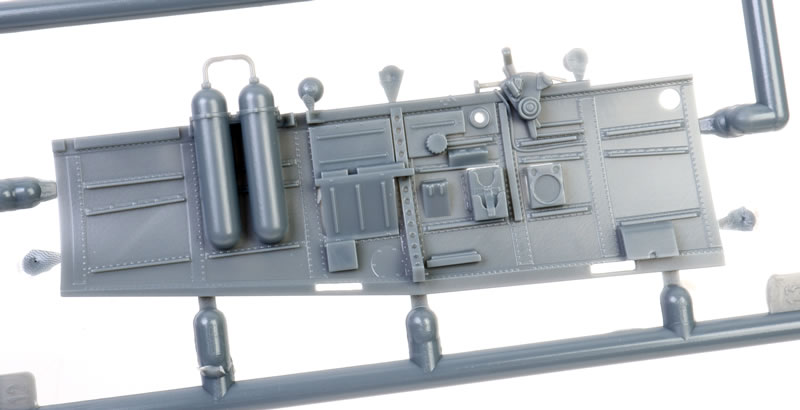
The kit is replete with similar examples – why design a seven-piece sub-assembly when you can mould it as one part? This seems to be the Kotare Spitfire’s philosophy.
I think this approach will appeal to many modellers who would like to build a beautifully detailed kit but feel intimidated by the daunting parts count of many recent releases.
It also points to Kotare’s Spitfire Mk.Ia as a kit to build, not to sit on the shelf.
Let’s take a closer look.
Surface textures are subtle and convincing. A combination of recessed panel lines, recessed fasteners and raised rivets delivers an authentic effect overall.
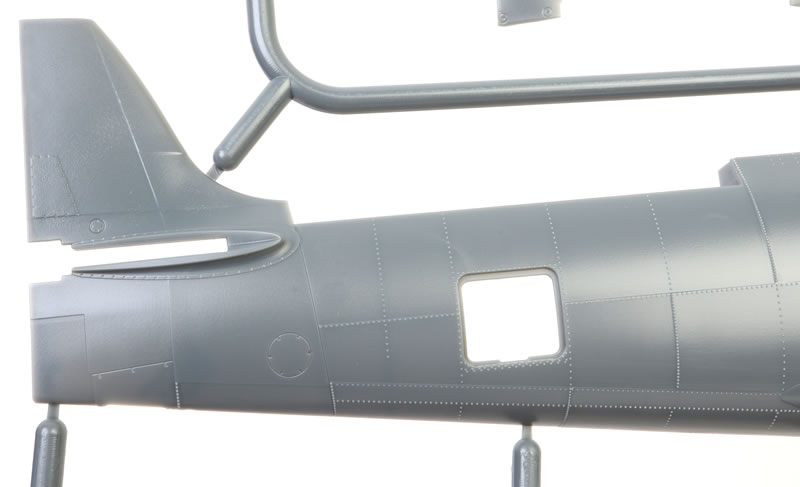
Fabric effect is limited to rows of stitching.
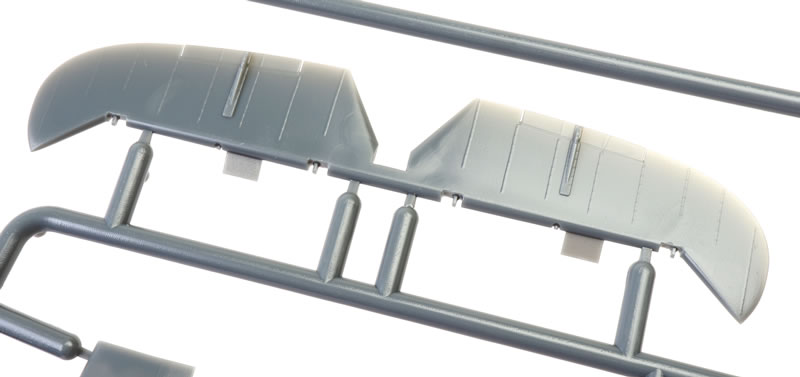
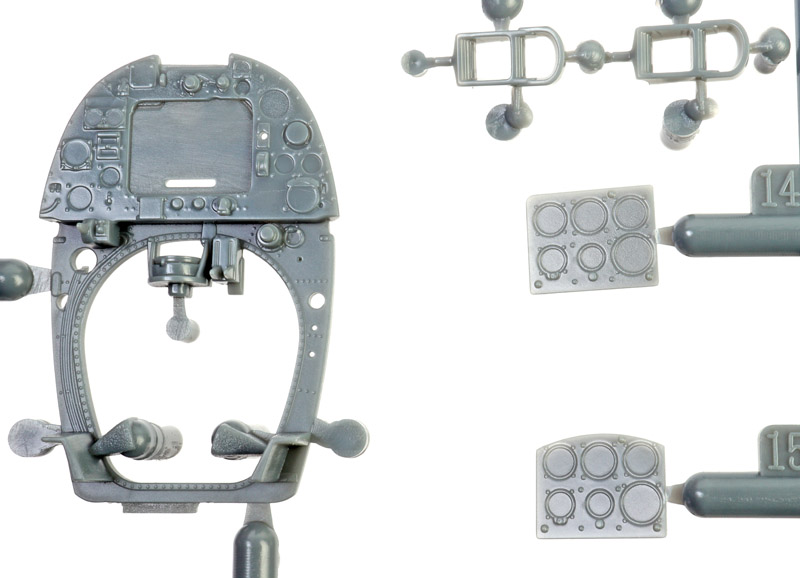
The cockpit is a work of art. I have already mentioned the sidewalls, but the seat and the instrument panel are also worthy of special notice. The instrument panel is a single solid plastic part with dial, bezel and switch detail moulded crisply in place. The compass and mount are moulded onto the bottom of the panel. Decals are supplied for the dial detail in single, pairs and trios.
I particularly like that Kotare has provided the option of a seat with moulded-on Sutton harness.
The cockpit floor accurately depicts the multi-layered bottomless effect. The control yoke is a separate part, allowing it to be posed to taste.
There is plenty of detail inside the fuselage aft of the pilot too.
Another nice touch is that Kotare provides a rigging guide for the rudder, aileron and elevator control lines, undercarriage retraction cables plus the attachment line for the shoulder harness mount.
The fuselage has a number of separate inserts and hatches including the accumulator door, wireless access hatch, engine cowlings and separate spine. These will presumably permit different variants to be offered in the future.
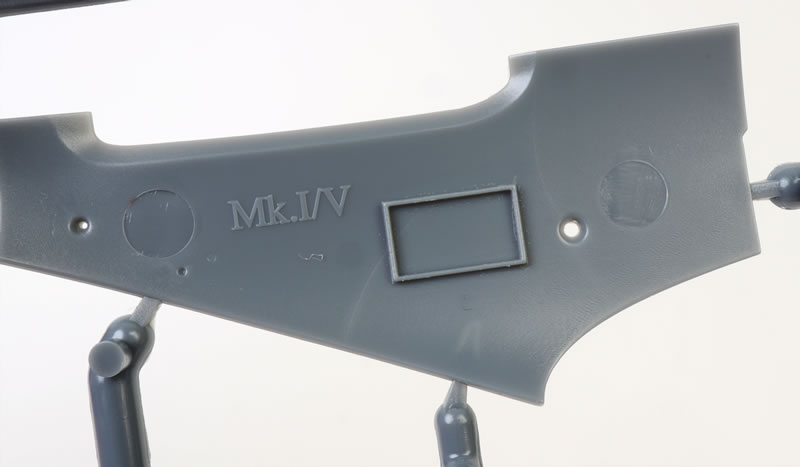
The cockpit door may be posed open or closed.
Wings are broken down conventionally with full-span lower and separate port and starboard upper wing parts. A long span wing spar is included, ensuring the correct dihedral. The eight Browning .303 machine gun barrels are located in correctly spaced and recessed in the lower wing. The instructions suggest the barrels may be drilled out for more detail.
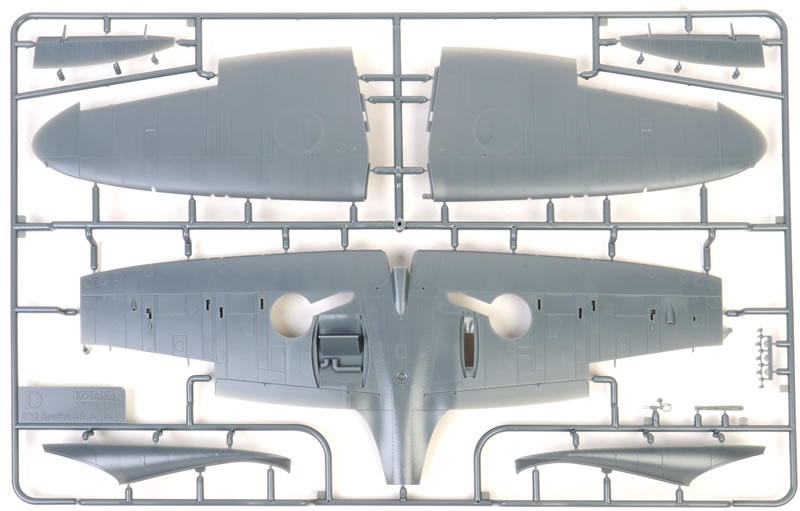
The wheel well walls are provided as a single part for each side. A really nice example of attention to detail is the jack for the early-style undercarriage part as separate parts for each landing gear well. You’ll need to drill or cut out a slot in the undercarriage walls to accommodate the jacks.
The five-spoke main wheels are supplied in two parts each (no vinyl - hooray!). They are bulged and flattened and keyed to make sure the flat spot sits on the ground.
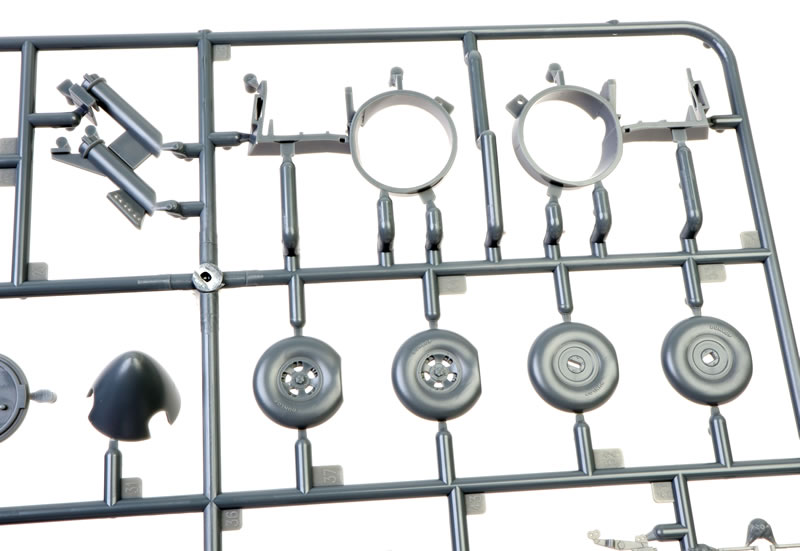
The wing fillets are separate parts, as are ailerons, elevators and rudder. The rudder and elevators are moulded with locating tabs, but you may simply cut these off if you wish to pose your rudder and elevators offset.
The kit offers the choice of de Havilland and Rotol spinner and propeller assemblies.
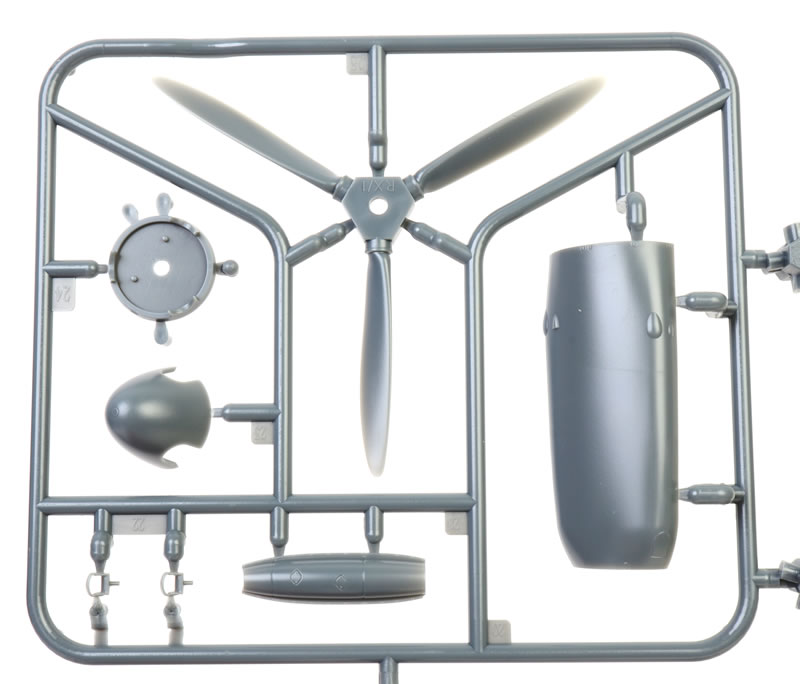
The propellers are moulded as a single part with the pitch already set.
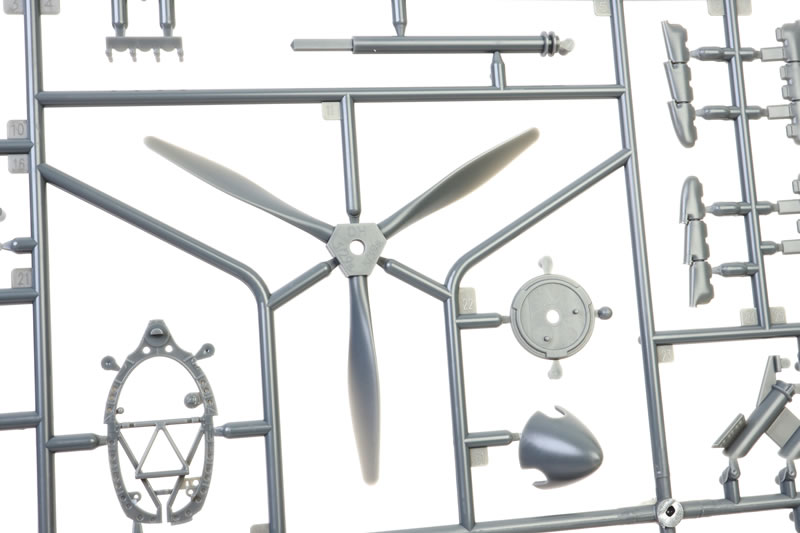
Optional mirrors and aerial masts are provided too (TR.9D and TR.1133).
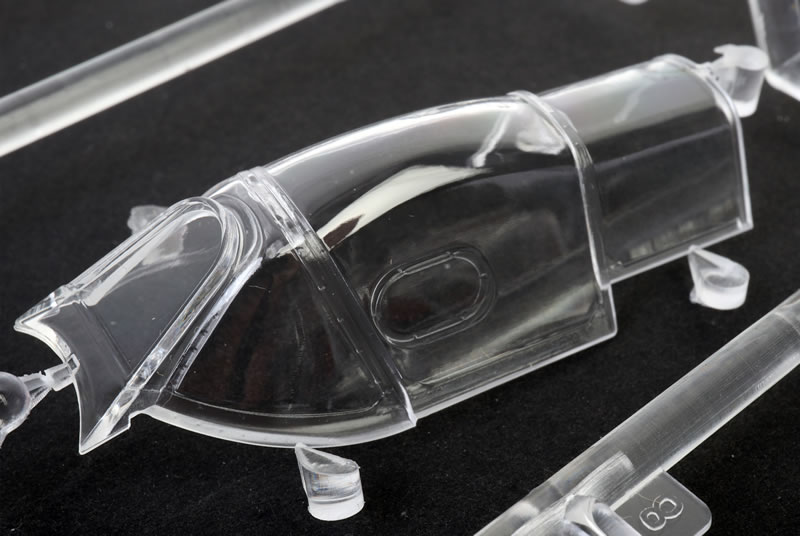
The clear parts are thin and free from distortion.
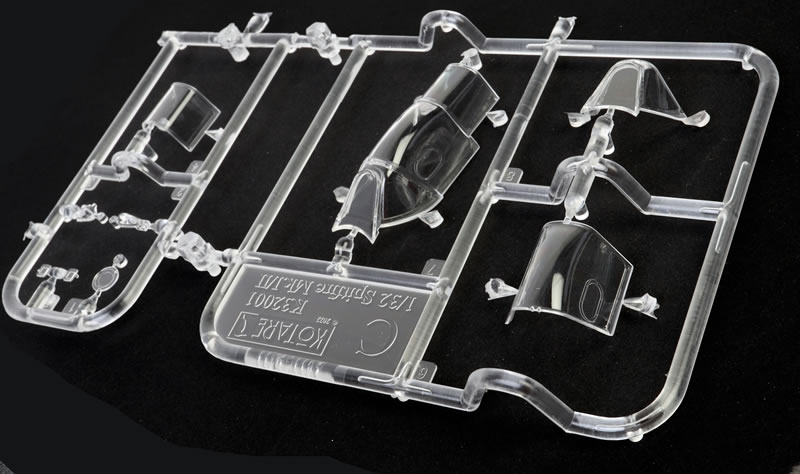
The canopy offers the choice of a single part if posed closed, or with separate windscreen, sliding section and rear for the open canopy option. The external armoured glass is moulded as part of the windscreen in both cases.
Instructions and Markings
The instructions are as much an educational experience as they are assembly directions. There are many detail notes as well as helpfully captioned reference photos and illustrations throughout.
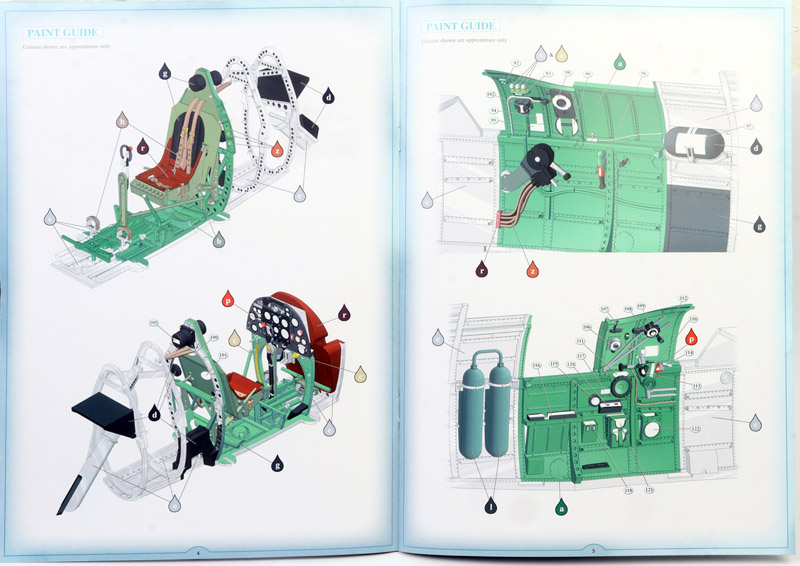
The 32 page full-colour A-4 book offers assembly instructions over 14 steps, four view colour illustrations for the three marking option plus reference photos and notes for each of the three marking options, stencil diagram and additional reference.
Marking Options
The large glossy Cartograf decal sheet offers three marking options plus stencils, instrument panel decals, nicely random leading edge machine gun patches and stencils.
Registration and colour saturation are perfect on my sample. They are printed in Italy so presumably Cartograf – another indicator of high quality.
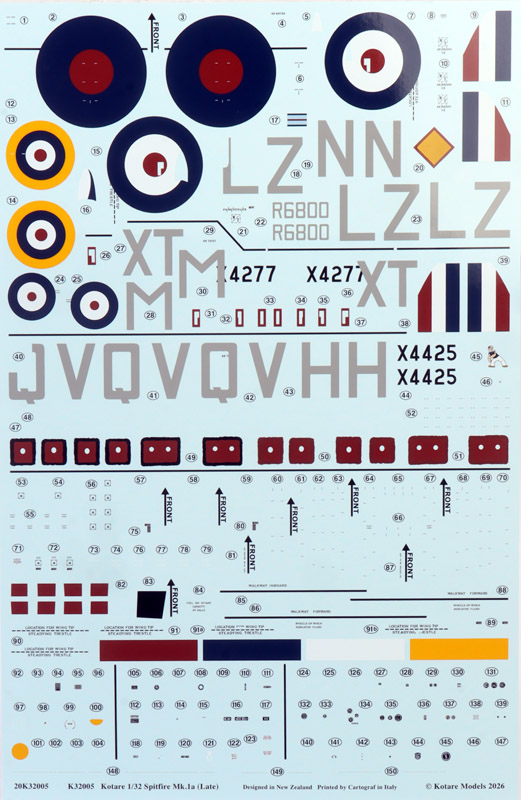
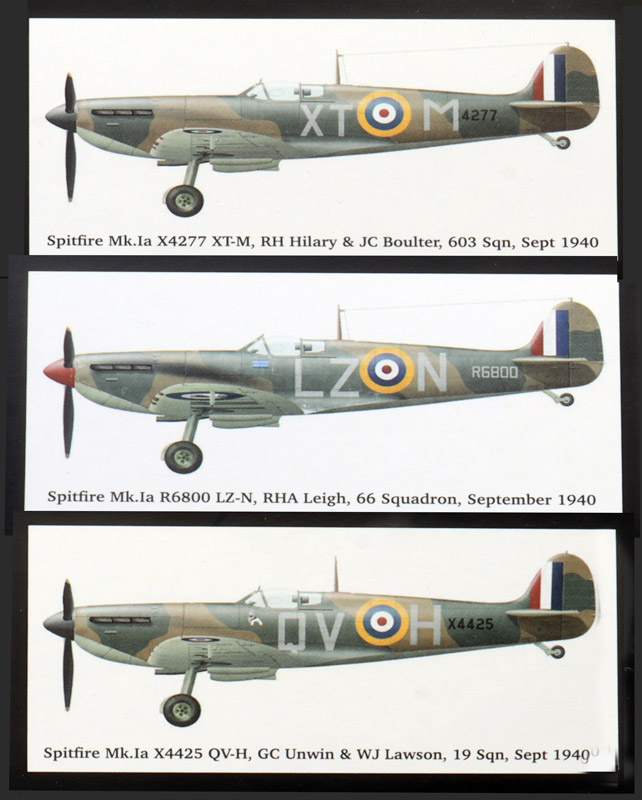
All three aircraft represent the height of the Battle of Britain in September 1940. They are:
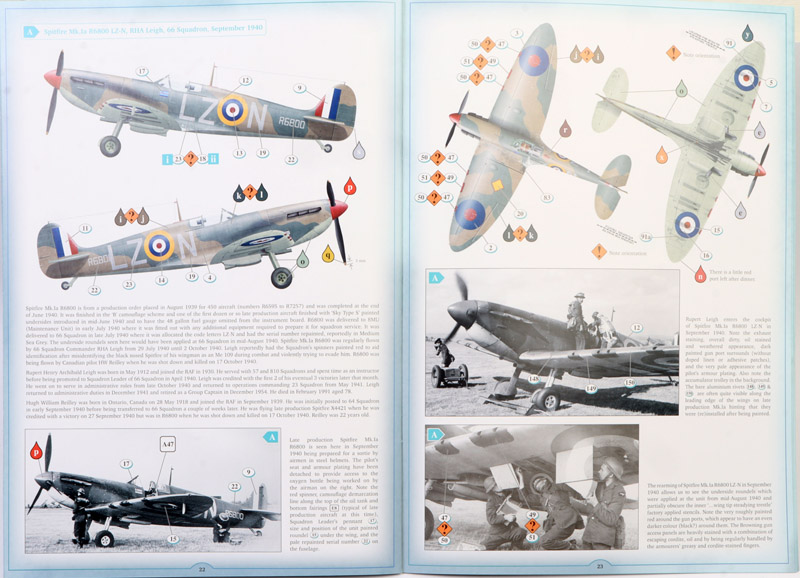
Option A – Spitfire Mk.Ia R6800, LZ-N flown by Flying Officer Hugh William Reilley, No. 66 Squadron RAF, September 1940
One of the RAF's oldest fighter units, No. 66 Squadron spent the Battle of Britain operating from RAF Coltishall before moving south to Gravesend as the fighting intensified. By September 1940 the squadron was heavily engaged intercepting Luftwaffe raids over southeast England. Flying Officer Hugh William Reilley was among the young pilots who shouldered the burden of these relentless daily sorties. Although not one of the Battle's highest-scoring aces, Reilley represented the capable and determined pilots whose perseverance proved just as important to Fighter Command's success. Spitfire R6800 typifies the mature Battle of Britain Mk.Ia, equipped with the improvements introduced during the preceding year of combat experience and flown at the height of the campaign when every interception carried strategic significance.
Option B – Spitfire Mk.Ia X4277, XT-M flown by Flight Lieutenant Richard Hillary and Pilot Officer John Coulter, No. 603 (City of Edinburgh) Squadron RAF, September 1940
Perhaps the best-known aircraft in the kit, X4277 is closely associated with Flight Lieutenant Richard Hillary, one of the Battle of Britain's most famous pilots. Hillary achieved five confirmed victories before being severely burned when his Spitfire was shot down over Kent on 3 September 1940. His remarkable recovery and subsequent memoir, The Last Enemy, became one of the most powerful personal accounts of the air war and remains a classic of Second World War literature. During September, X4277 was also flown by Pilot Officer John Coulter as 603 Squadron continued its intensive operations from RAF Hornchurch. Based close to the front line of the battle, the squadron flew repeated interceptions against German bomber formations and their Bf 109 escorts, making aircraft such as X4277 representative of the desperate struggle fought over southern England.
Option C – Spitfire Mk.Ia X4425, QV-H flown by Flying Officer George Charles Unwin and Pilot Officer John Lawson, No. 19 Squadron RAF, September 1940
No. 19 Squadron occupies a unique place in RAF history as the first operational unit to receive the Supermarine Spitfire in August 1938. By the Battle of Britain it was among Fighter Command's most experienced Spitfire squadrons. Flying Officer George "Grumpy" Unwin had already established himself as one of the squadron's leading pilots, claiming numerous victories during the Battle and eventually becoming one of the RAF's distinguished fighter aces. Pilot Officer John Lawson also flew X4425 during this period as the squadron defended London and southeast England from sustained Luftwaffe attacks. The aircraft therefore represents not only the mature development of the Spitfire Mk.Ia but also the operational experience accumulated by the RAF's first Spitfire squadron after two years of flying the type.
Kotare's latest release is less about new tooling than it is about historical refinement. Their original Spitfire Mk.I established a benchmark for engineering and accuracy, while this edition captures the mature Battle of Britain fighter that incorporated the lessons of the first year of the Second World War.
The arrangement of sprues reflect important production changes that distinguished late Mk.Is from their earlier counterparts. For anyone wishing to build what many regard as the definitive Battle of Britain Spitfire, Kotare has delivered an exceptionally well-researched and beautifully executed kit.
Kotare does not subscribe to the idea that every new release demands a pile of new plastic. Instead, they are using an already outstanding kit as a platform to tell different historical stories. This release isn't exciting because it has dozens of new sprues—it doesn’t. It is exciting because it accurately depicts a very specific and critical point in the Spitfire's evolution.
We have seen this same approach with their earlier PR. Type A and Brian Lane boxings.
I can’t wait to see the next Chapter!
Thanks to Kotare Models for the sample
Text and Images Copyright © 2026 by Brett Green
Page Created 4 August, 2026
Last updated
4 August, 2026
Back to HyperScale Main Page
Back to Reviews Page
|
 Home
| What's New |
Features |
Gallery |
Reviews |
Reference |
Forum |
Search
Home
| What's New |
Features |
Gallery |
Reviews |
Reference |
Forum |
Search