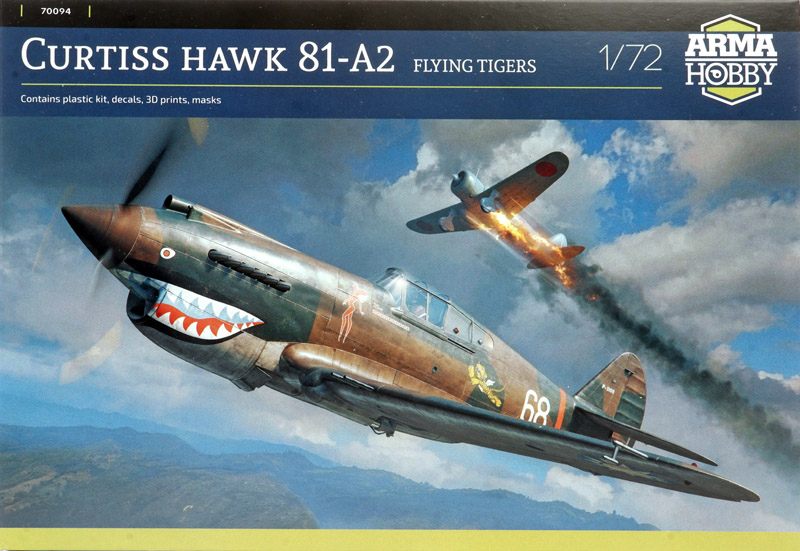
Arma Hobby Kit No.70094 - Curtiss Hawk 81-A2 Flying Tigers
Contents and Media:
55 parts in light grey plastic; one 3d printed part; five parts in clear plastic; yellow Kabuki die-cut self-adhesive paper masks; decals for three marking options; link to downloadable 3d detail parts; includes assembly jig made from four clear parts.
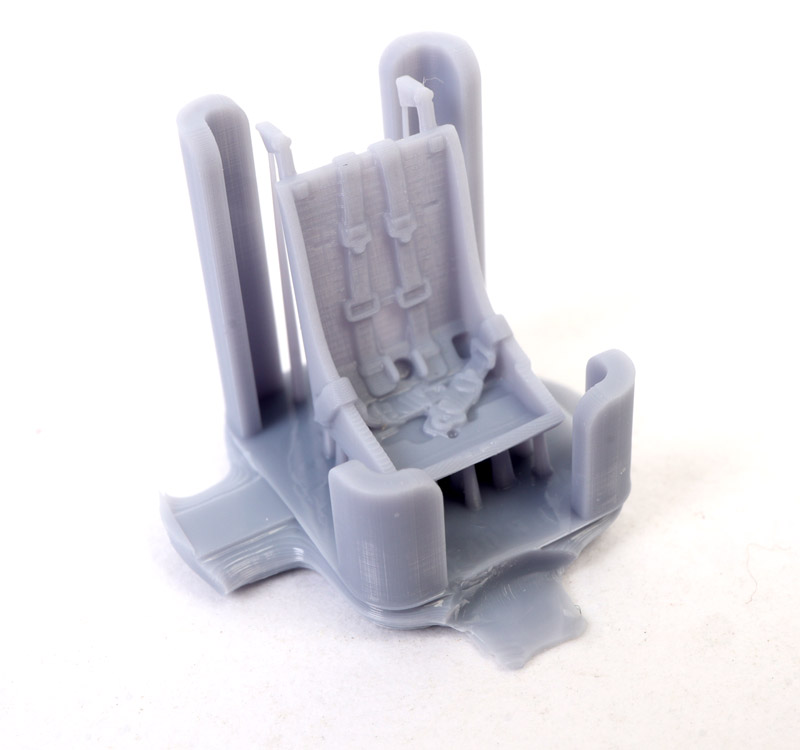
High quality moulding; gorgeous surface textures and detail; poseable canopy; includes 3d printed seat with integrated harness straps; high quality Cartograf decals.
Disadvantages:
Side opening box.
Recommendation:
Arma Hobby’s Hawk 81-A2 is clearly the new benchmark for the early Hawk 81 / P-40 in 1/72 scale.
The kit delivers a high level of detail, finely rendered surface textures and crisp moulding throughout, while its modest parts count will deliver a straightforward build without compromise. The 3D-printed seat and downloadable accessories add further refinement.
Add beautifully printed Cartograf decals and three attractive Flying Tigers subjects, and this is another highly impressive Arma Hobby release.
Highly Recommended.
Reviewed by Brett Green
Introduction
The Curtiss Hawk 81-A2 represented the culmination of Curtiss’ attempt to extract more performance from its successful Hawk 75, known in US service as the P-36. The radial-engined Hawk 75 fighter was competitive when introduced in 1935, but rapidly advancing aircraft design exposed its limitations. Curtiss therefore adapted the airframe to accommodate the new liquid-cooled Allison V-1710 V12. An early attempt, the turbo-supercharged XP-37, suffered from poor visibility and unreliable supercharging, but the subsequent XP-40 adopted a mechanically supercharged Allison and proved sufficiently promising to enter production.
The new engine transformed the Hawk's appearance, replacing the P-36's broad radial cowling with a long, streamlined nose and repositioned radiator. The production Hawk 81 retained the basic wing and fuselage structure but incorporated heavier armour, self-sealing fuel tanks and revised armament. The H81-A2 was the export equivalent of the P-40B/C family, with British .303-in Brownings in the wings on Tomahawk IIA aircraft.
Although not a match for the finest contemporary fighters at altitude or in a turning fight, the Hawk's rugged construction, heavy armament and excellent diving characteristics made it an effective combat aircraft when properly employed. It achieved legendary status with the American Volunteer Group, the Flying Tigers, in China and Burma, while early P-40s also flew during the Japanese attack on Pearl Harbor.
Tomahawks equipped RAF and Commonwealth squadrons in the Western Desert, where their strength and diving performance proved valuable in the demanding air war over North Africa. Others were supplied to the Soviet VVS, seeing extensive service on the Eastern Front.
The Hawk 81 was ultimately outclassed by newer fighters, but its availability, ruggedness and versatility ensured an important legacy as one of the most widely employed Allied fighters of the early Second World War.
Hawk 81 / P-40B/C Kits in 1/72 scale
The best Hawk 81 / P-40B/C options until now include:
Airfix Kit No. A01003 — The Airfix kit is still a good choice. It was a completely new tool when released in 2011 and received good feedback for its outline, fit, surface textures and optional features. Its main weakness compared with Arma's new kit is that it now looks less refined, particularly in cockpit detail and the treatment of small surface features. The one-piece canopy is also noticeably thick. Nevertheless, it builds into an attractive Hawk 81/P-40B and has the advantage of being widely available.
Academy Kit No. 12456 — This budget option is inexpensive and readily available, but it can't be considered as a good option today. Reviews have been critical of its accuracy and overall execution.
HobbyBoss Kit No. 80209, released around 2019, also offers an early P-40B/C, but it lags behind both Arma and Airfix. It may produce a respectable model, but it does not offer the same combination of accuracy, finesse and variant-specific detail.
There are a number of other 1/72 scale options including Trumpeter, AML and AZ Model, but in 2026 these fall into the category of also-rans.
FirstLook
Arma Hobby has added another classic to their ever-growing range, a 1/72 scale Curtiss Hawk 81-A2.
Arma Hobby's 1/72 scale Curtiss Hawk H-75 kits featured a modest parts count and in fact the new long-nose Hawk 81-A2 has even fewer.
The kit comprises just 55 parts in light grey plastic; five parts in clear plastic, yellow Kabuki die-cut self-adhesive paper masks, decals for three marking options, a link to downloadable 3d detail parts and a four-part clear plastic assembly jig.
The small parts count does not in any way suggest a lack of detail. To the contrary, detail is excellent, even pipping its H75 predecessors in a number of areas.
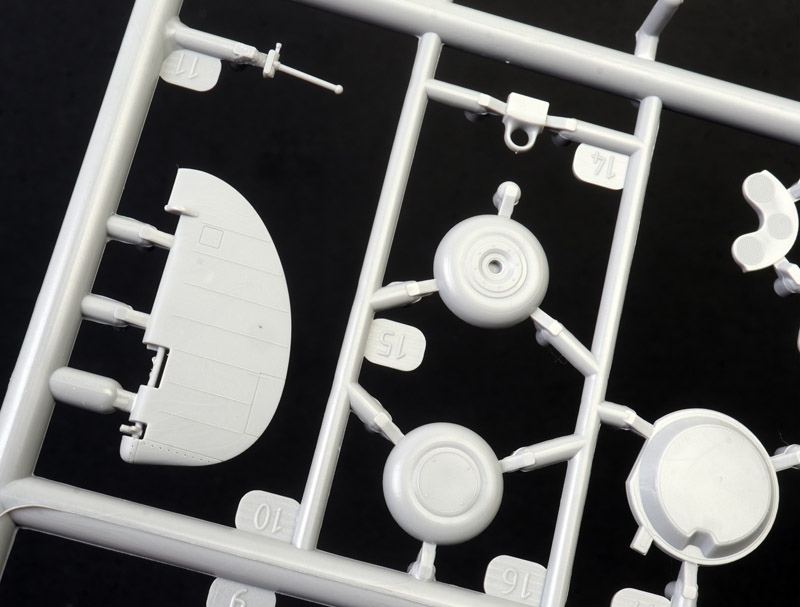
The grey plastic parts are delivered on just two sprues. Moulding quality is excellent. The plastic parts boast a lovely smooth texture.
Being a long-run kit, the parts are moulded with all the alignment aids that you would expect including pins, holes, slots and tabs.
Moulding quality is excellent.
Some of the sprue attachments are moulded to the surfaces of the kits so take care when cutting these off and cleaning them up.
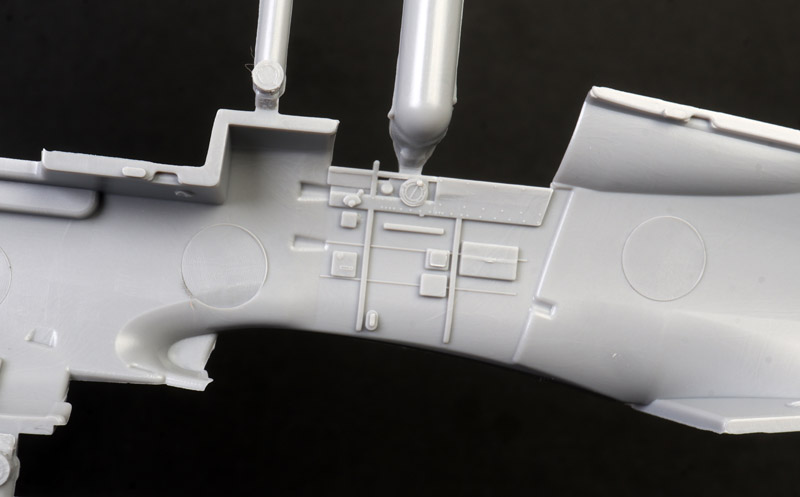
Surface textures are just gorgeous. Recessed panel lines, raised details, circular fastener heads and other structural details are very fine.
The fuselage is supplied as left and right halves.
The cockpit floor is moulded as the centre section of the wings.
Some cockpit sidewall detail is moulded directly to the inside of the fuselage halves.
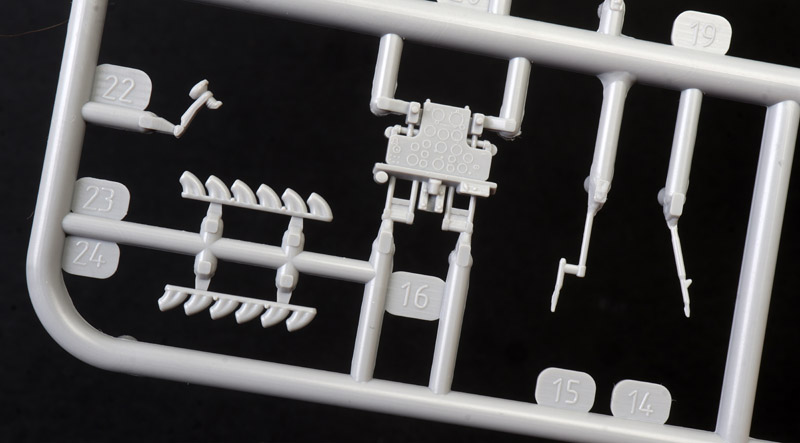
Additional separate parts include the instrument panel with a moulded pair of rudder pedals, throttle quadrant with switch boxes, control column and more.
The instrument panel features raised detail that will respond well to careful dry brushing. Rudder pedals are moulded to the bottom of the panel frame.
As an option, an overlay decal is supplied for the instrument panels and switch panel. Harness strap decals are included as well.
Arma has generously included a 3d printed resin pilot's seat with harness straps printed in place. Once again, detail is excellent.
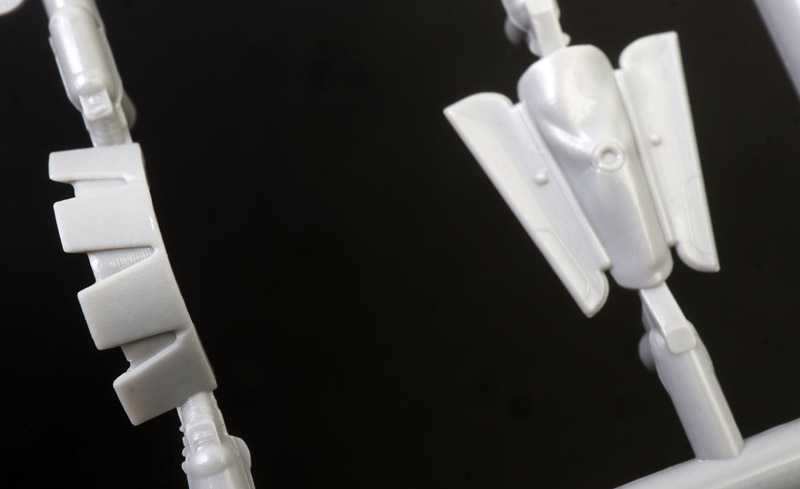
The cowl flaps are moulded as one piece. They are posed open.
The wing parts are full span lower and upper halves. They are suitably thin at the trailing edges. Aileron hinge lines are appropriately heavier than the general panel line detailing. Fabric stitching is represented effectively as fine raised lines.
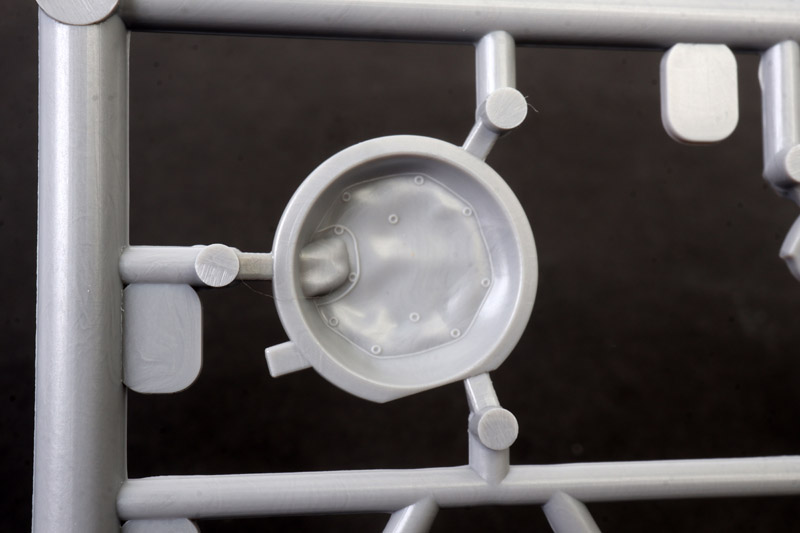
The main wheel wells are nicely done with convincing drape, texture and detail of the canvas covers. This one-piece solution per side is simple to install and convincing to behold.
Moulding quality is excellent overall.
The tail wheel and strut are moulded as a single part with the central dust cover and tail wheel doors are also moulded in one. Detail looks good .
There aren't many optional parts. The only ones I could find on the sprue were alternative pitot tubes.
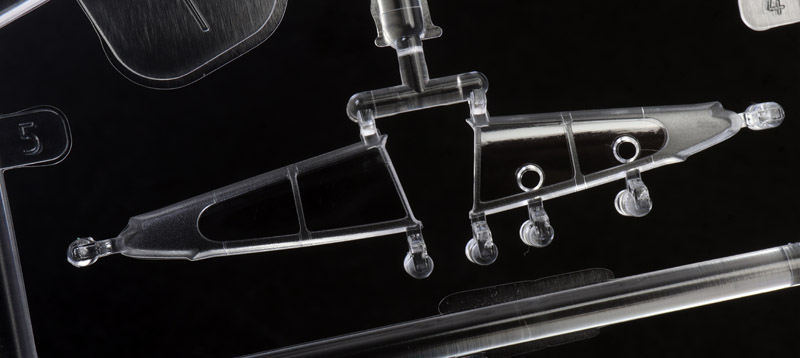
Canopy parts are impressively transparent and free from distortion. The pilot's armoured glass is moulded as a separate part.
I particularly like that the windscreen and each rear side window is moulded with a small section of fuselage, reducing the risk of smudging those nice clear parts.
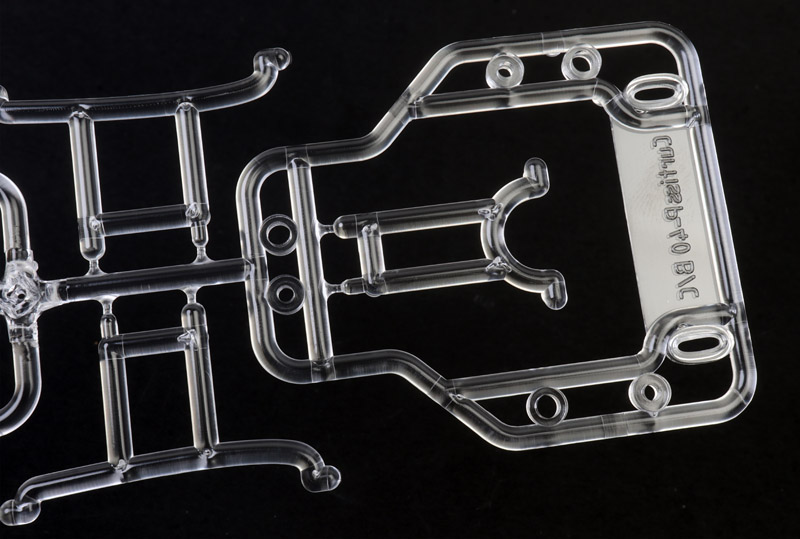
A jig made up from four clear parts will assist setting the correct landing gear geometry.
The jig may also be used as a secure transport method.
Instructions are supplied as an eight page stapled A5-sized booklet.
The kit is packed into a end-opening cardboard box that is a bit flimsy.
Downloadable 3d Printed Parts
The instructions have a link to a QR code that will allow the free download of a 3D file with accessories for self-printing.
Marking Options
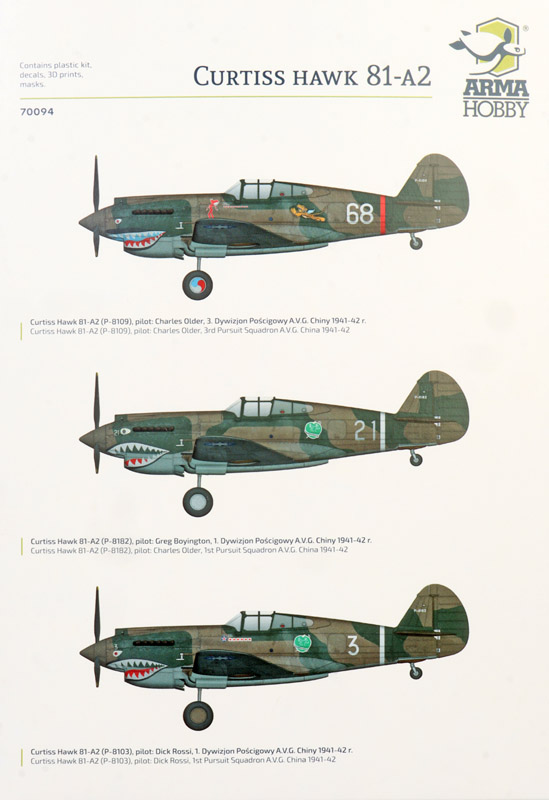
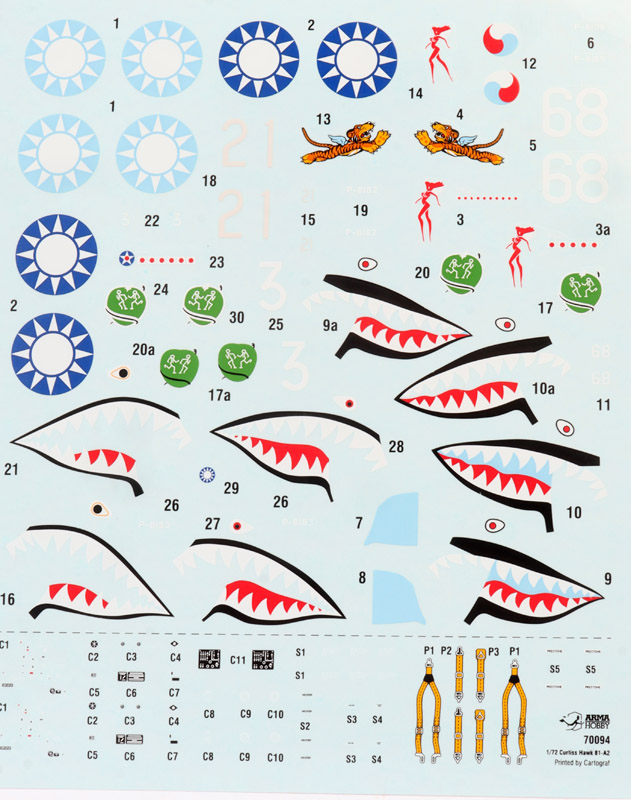
The kit decal sheet offers markings for three options:
They are:
Curtiss Hawk 81-A2 P-8109, flown by Charles Older of the 3rd Pursuit Squadron "Hell's Angels", American Volunteer Group (Flying Tigers), China, 1941–1942. Aircraft of one of the AVG's highest-scoring aces during the defence of China.
Curtiss Hawk 81-A2 P-8182, flown by Greg "Pappy" Boyington of the 1st Pursuit Squadron "Adam & Eves", American Volunteer Group (Flying Tigers), China, 1941–1942. The aircraft represents Boyington's service with the AVG before he became the famous commander of the legendary VMF-214 "Black Sheep".
Curtiss Hawk 81-A2 P-8103, flown by Dick Rossi of the 1st Pursuit Squadron "Adam & Eves", American Volunteer Group (Flying Tigers), China, 1941–1942. One of the best-known Flying Tigers aircraft used during the defence of China in the opening months of the Pacific War.
Stencil markings are printed on the same single sheet, as are propeller logos and wing walk markings.
Decals are printed perfectly by Cartograf, so you know they'll be good!
They are luxuriously glossy, colours are well saturated and everything is in perfect register.
Conclusion
Arma Hobby’s Hawk 81-A2 is clearly the new benchmark for the early Hawk 81 / P-40 in 1/72 scale.
The kit delivers a high level of detail, finely rendered surface textures and crisp moulding throughout, while its modest parts count will deliver a straightforward build without compromise.
The 3D-printed seat and downloadable accessories add further refinement.
Add beautifully printed Cartograf decals and three attractive Flying Tigers subjects, and this is another highly impressive Arma Hobby release.
 Home
| What's New |
Features |
Gallery |
Reviews |
Reference |
Forum |
Search
Home
| What's New |
Features |
Gallery |
Reviews |
Reference |
Forum |
Search