Curtiss H-75A1/A2
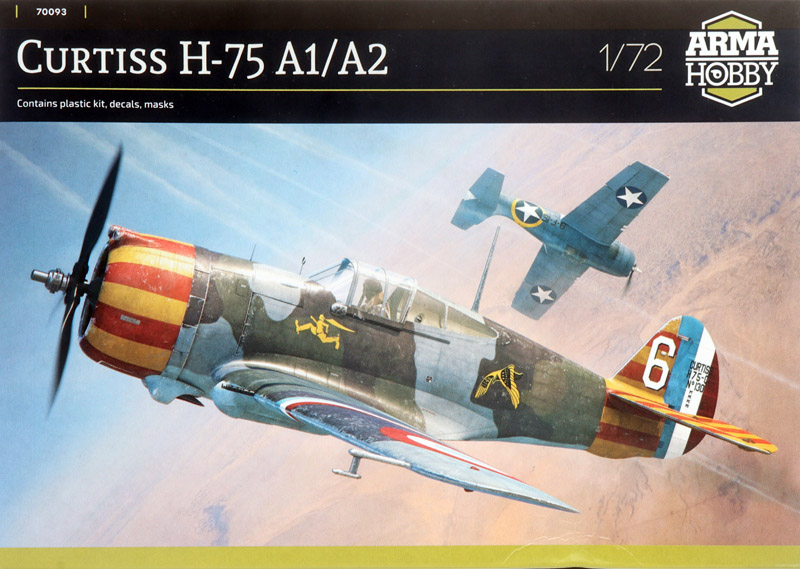
Arma Hobby, 1/72 scale
S
u m m a r y : |
Description and Item No.: |
Arma Hobby Kit No.70093- Curtiss H-75A1/A2 |
Contents and Media: |
75 parts in light grey plastic; seven parts in clear plastic; yellow Kabuki die-cut self-adhesive paper masks; decals for three marking options; link to downloadable 3d detail parts. |
Price: |
€22.12 plus shipping available online at Arma Hobby
Hannants UK Price £TBA
and hobby retailers worldwide |
Scale: |
1/72 |
Review Type: |
First Look |
Advantages: |
High quality moulding; gorgeous surface textures and detail; poseable canopy; high quality Cartograf decals. |
Disadvantages: |
Side opening box. |
Recommendation: |
Arma Hobby's 1/72 scale Curtiss H-75A1/A2 is a little gem of a kit with its crisp surface textures, high moulding quality, thoughtful parts breakdown, useful options and high level of detail. This is a another excellent offering from Arma Hobby.
Highly Recommended. |
Reviewed by Brett Green

The Curtiss H-75 was the export development of the Model 75 fighter that became the US Army Air Corps’ P-36 Hawk. An all-metal, low-wing monoplane with retractable landing gear and a radial engine, the H-75 was ordered by France as an interim modern fighter while French manufacturers struggled to meet rearmament demands. The French aircraft received the local designation H75-C1, while Curtiss identified the successive production batches as H-75 A-1, A-2, A-3 and A-4.
The H-75A-1 represented the initial French production batch of 100 aircraft. Powered by a 1,050 hp Pratt & Whitney R-1830 Twin Wasp, it carried four 7.5 mm machine guns – two mounted in the upper forward fuselage and one in each wing. French-specific equipment included metric instruments, a French-style throttle arrangement and other cockpit modifications.
The H-75A-2, of which a further 100 were ordered, introduced a significant increase in firepower. Two additional 7.5 mm guns were installed in the wings, bringing the total to six, while the rear fuselage was strengthened. Early A-2s could retain the earlier engine, but the definitive installation was the improved R-1830-SC3G. Externally, the A-1 and A-2 remained very similar, making the additional wing armament and associated gun access panels useful distinguishing features. The later A-3 retained the six-gun arrangement but adopted a 1,200 hp R-1830-S1C3G, while the A-4 used a 1,200 hp Wright Cyclone and consequently had a distinctly different, shorter and wider engine cowling.
H-75A-1s entered French service during 1939, followed by the A-2. By the Battle of France in May–June 1940, H-75s equipped several frontline Groupes de Chasse, including GC I/4, II/4, I/5 and II/5. They proved rugged and highly manoeuvrable and gave a good account of themselves against the Luftwaffe, although their speed and armament left them at a disadvantage against the Messerschmitt Bf 109E. The type nevertheless accounted for numerous German aircraft, with H-75-equipped units producing several French fighter aces.
Following the French armistice, surviving H-75s were concentrated in French North Africa, where they continued in service with the Vichy Armée de l'Air. They saw combat against British forces during the Mers-el-Kébir and Dakar operations and, most significantly, against the American invasion force during Operation Torch in November 1942. Vichy H-75s intercepted US Navy Grumman F4F Wildcats over Morocco and Algeria; French claims amounted to seven American fighters destroyed, while 15 H-75s were lost.
Another chapter began when Germany transferred captured French H-75s to Finland. Thirty-six former French aircraft were acquired, including A-1 and A-2 examples.
By 1943, these Curtisses were serving with Lentolaivue 32 (LeLv 32), where Finnish pilots employed them operationally against Soviet forces during the Continuation War. Finnish H-75s received local serials beginning with CU-501 and CU-551 and remained frontline aircraft rather than merely training machines. One former French H-75A-2, for example, became CU-577 and served with LeLv 32 at Nurmoila in 1943.
Arma Hobby released its Curtiss H-75A-1/A-2 (Kit No. 70080) in 2025, but the kit sold out quickly.
It is therefore pleasing to see the kit return in new packaging, now covering the Curtiss Hawk H-75A-1/A-2 in French, Vichy and Finnish service.
This latest offering provides marking options representing three operators, spanning the aircraft's service in France in 1940, with Vichy forces in North Africa in 1942, and with the Finnish Air Force in 1943.
Arma Hobby's 1/72 scale Curtiss Hawk H-75A-1/A-2 comprises 75 parts in light grey plastic; seven parts in clear plastic, yellow Kabuki die-cut self-adhesive paper masks, decals for three marking options and a link to downloadable 3d detail parts.
The grey plastic parts are delivered on just two sprues. Moulding quality is excellent. The plastic parts otherwise boast a lovely smooth texture.
Being a long-run kit, the parts are moulded with all the alignment aids that you would expect including pins, holes, slots and tabs.
Moulding quality is excellent.
Some of the sprue attachments are moulded to the surfaces of the kits so take care when cutting these off and cleaning them up.
Surface textures are just gorgeous. Recessed panel lines, raised venbts, circular fastener heads and other structural details are very fine.
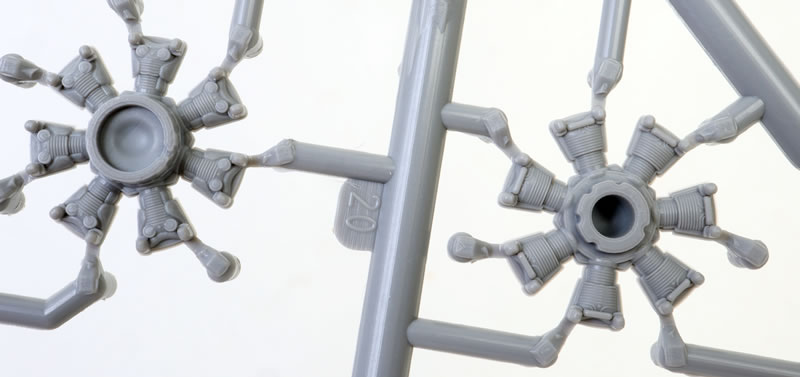
The fuselage is supplied as left and right halves. The engine is simply broken down into three parts but detail is not compromised.
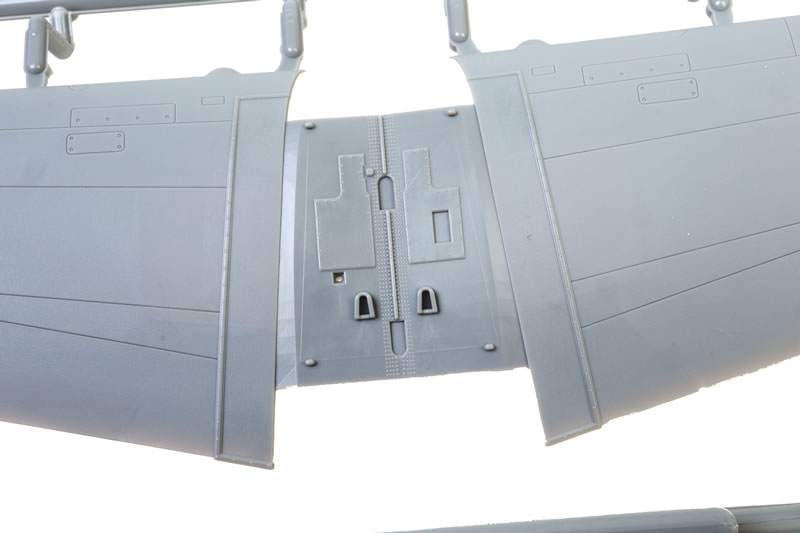
The cockpit floor is moulded as the centre section of the wings.
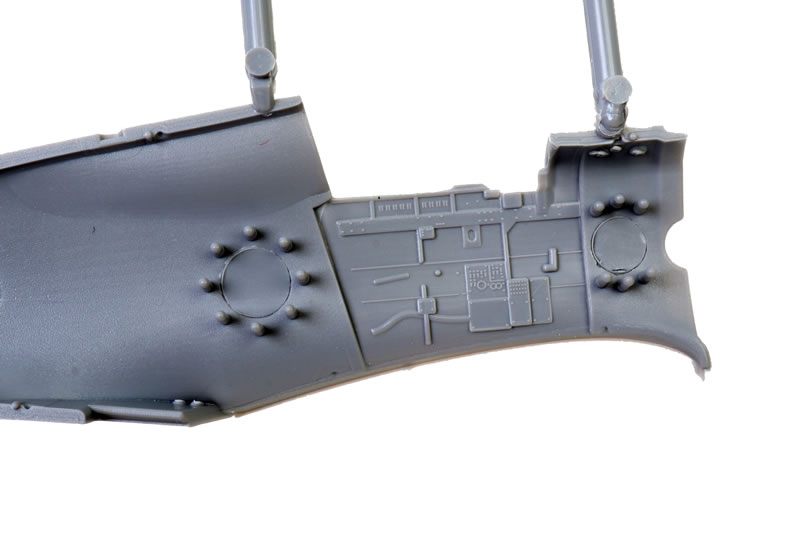
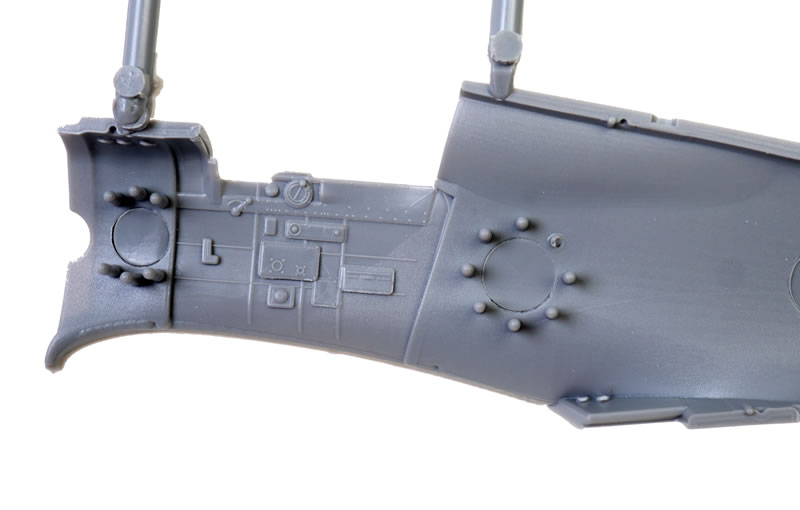
Some cockpit sidewall detail is moulded directly to the inside of the fuselage halves.
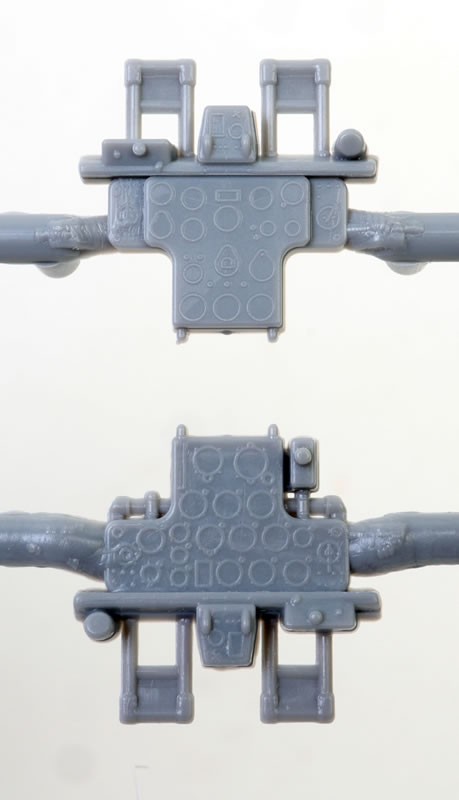
Additional separate parts include, throttle quadrant; instrument panel with a moulded pair of rudder pedals, control column and more.
The instrument panel features raised detail that will respond well to careful dry brushing. Rudder pedals are moulded to the bottom of the panel frame.
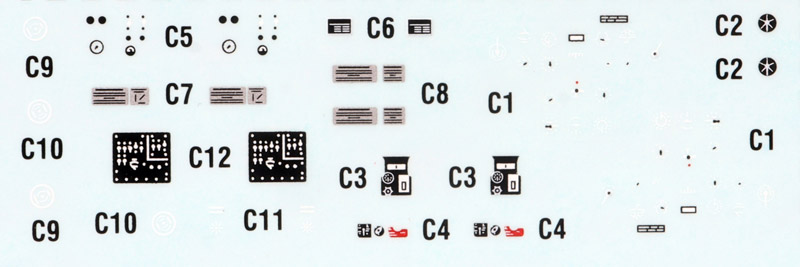
As an option, overlay decals are supplied for the instrument panels and switch panels. Harness strap decals are included as well.
There are some really nice plastic details in the cockpit too.
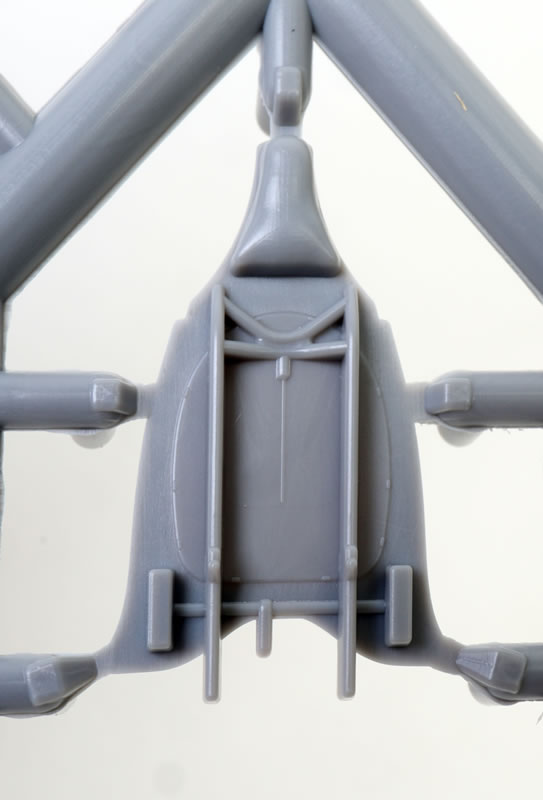
The wing parts are full span lower and upper halves. They are suitably thin at the trailing edges. Aileron hinge lines are appropriately heavier than the general panel line detailing.
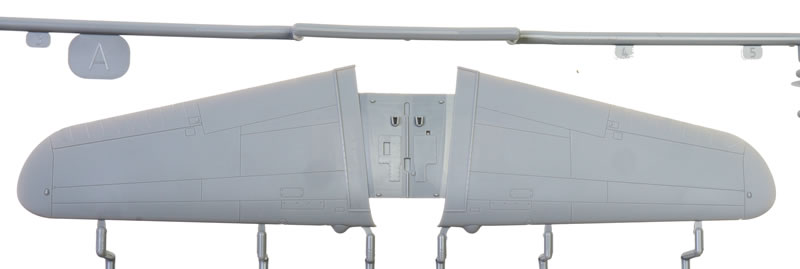
The main wheel wells are nicely detailed. The sidewalls start life as a flat plastic strip scored in three places. The strip is then folded into a box representing the four sides of the wheel wells. I would suggest that you apply a small amount of liquid cement to the folding recesses, but be very careful when folding the parts,. A separate domed ceiling is also supplied for each side.
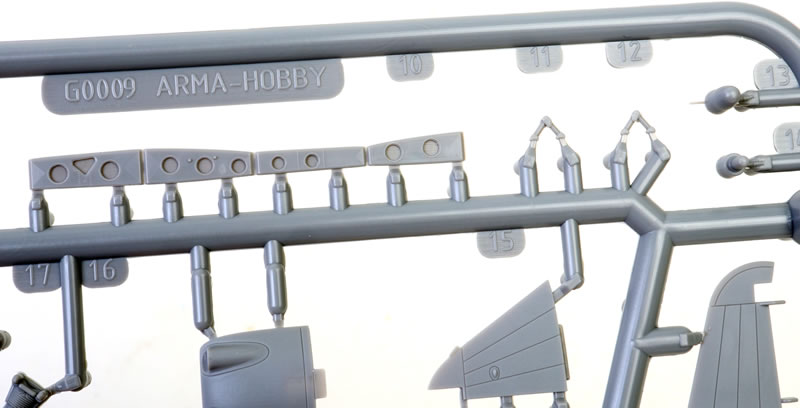
The wheels are subtly bulged and flattened with a fine radial tread.
Elevators and rudder are moulded as separate parts and may be posed to taste.
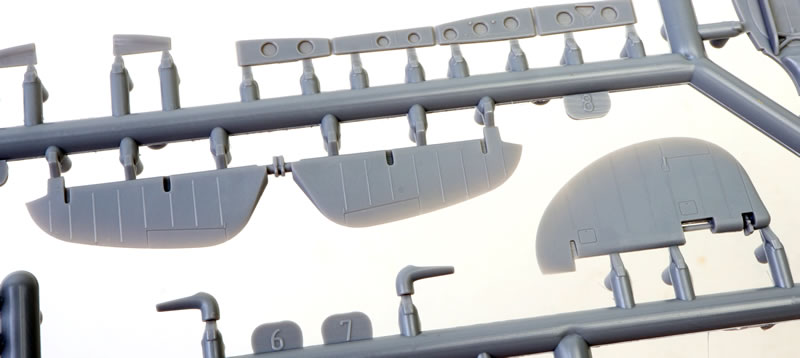
The tail wheel and strut are moulded as a single part. Detail looks fine.
A number of additional parts and unused options are included on the sprues.
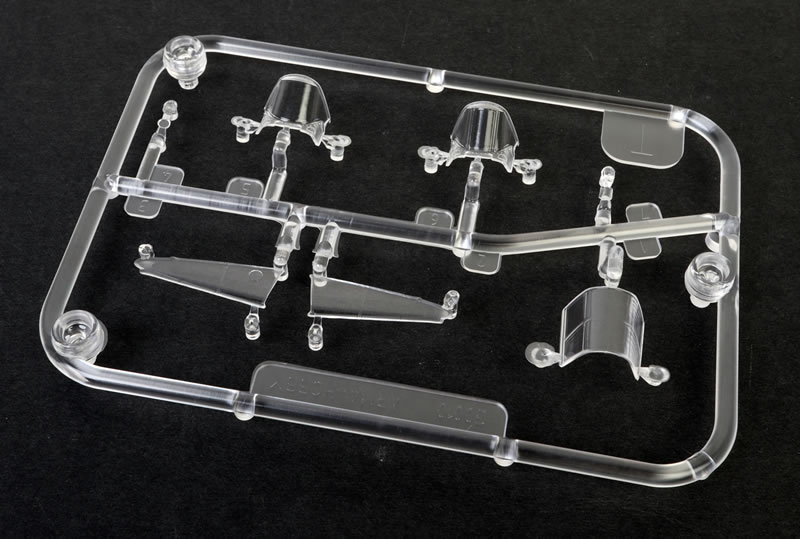
Clear parts are impressively transparent and free from distortion.
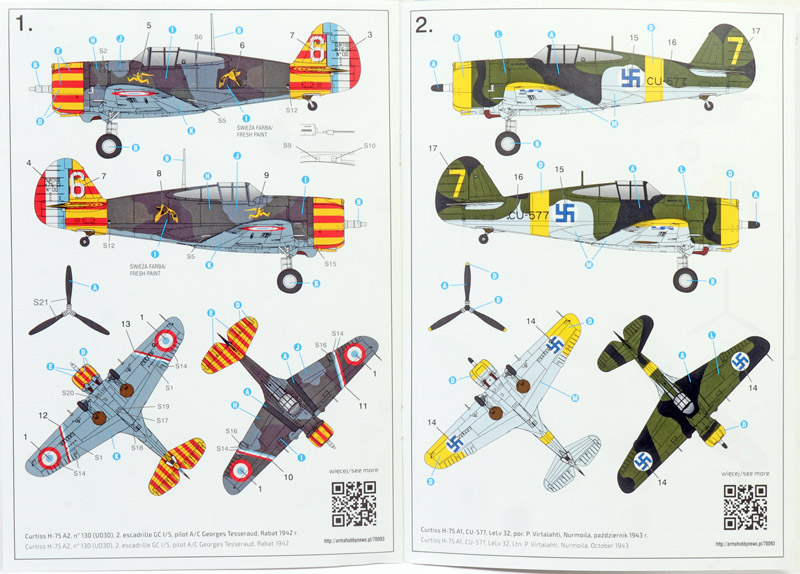
Instructions are supplied as an eight page stapled A5-sized booklet.
The kit is packed into a end-opening cardboard box that is a bit flimsy.
Downloadable 3d Printed Parts
The instructions have a link to a QR code that will allow the free download of a 3D file with accessories for self-printing.
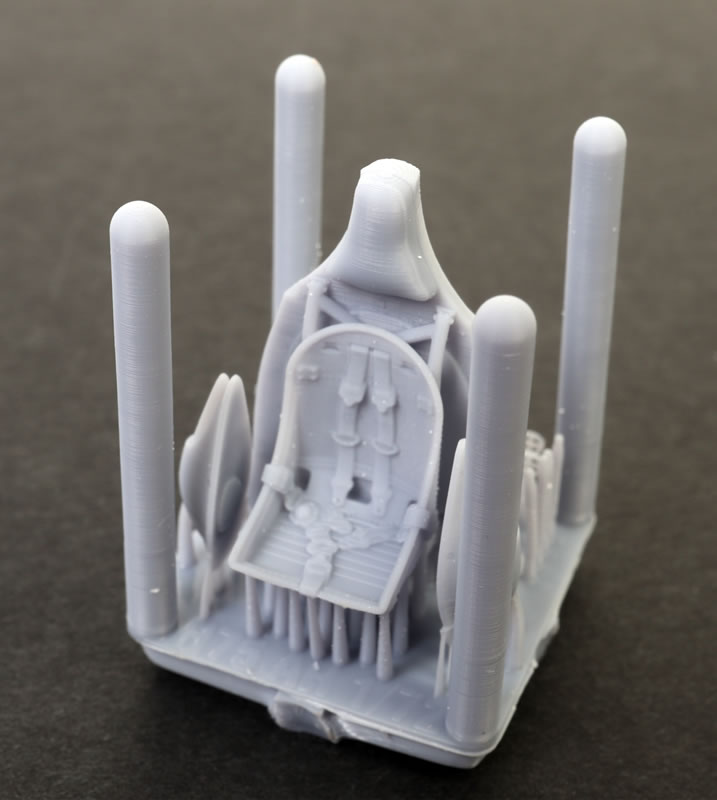
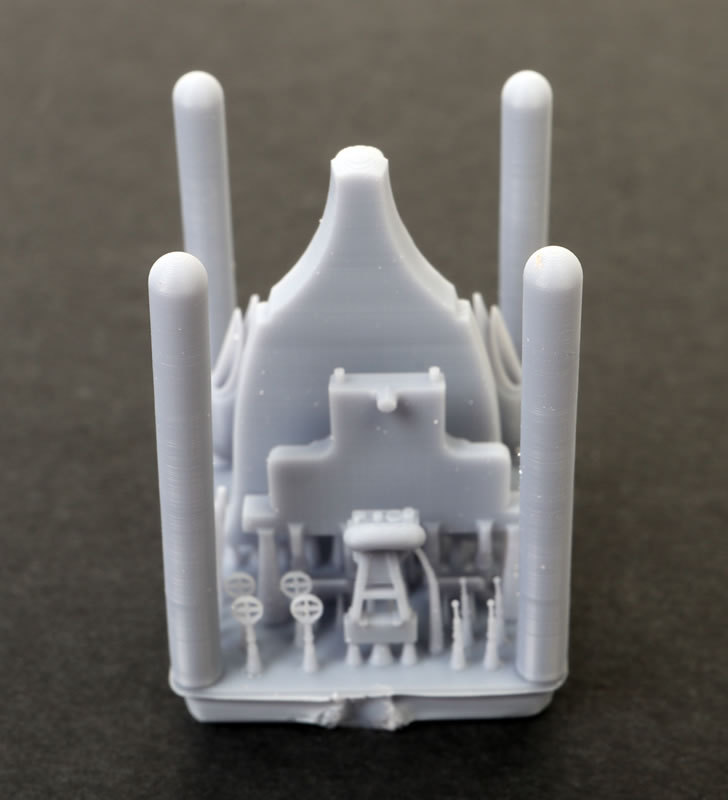
The 3D parts include:
-
Bulkhead with seat and seatbelts (single part, very clever)
-
Instrument panel with rudder pedals
-
Exhaust tubes with covers
-
Gun barrels
-
Reflector gunsight
-
Ring and bead gunsight
Marking Options
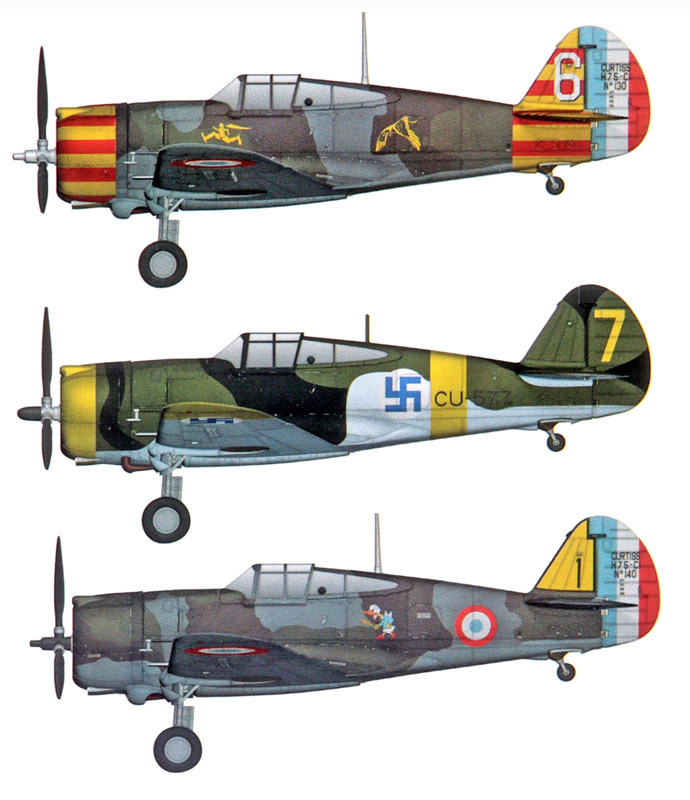
The kit decal sheet offers markings for three options:
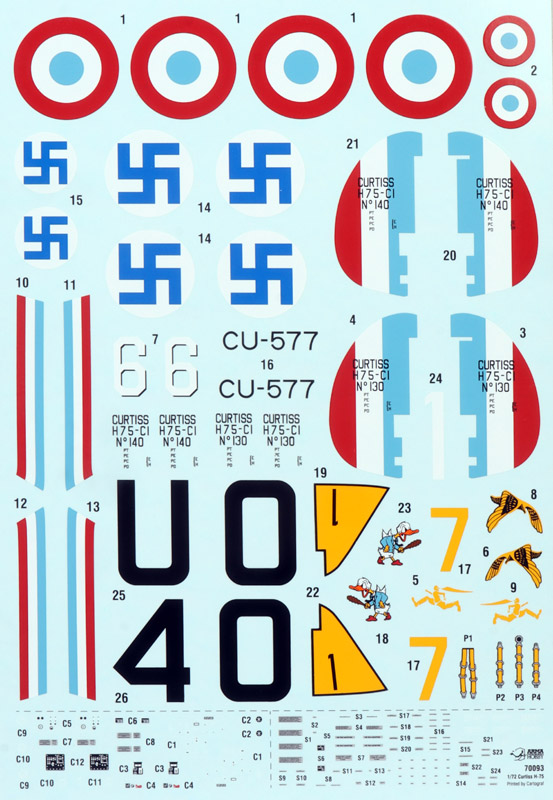
They are:
-
H-75A-2 No. 130 (U030) – Georges Tesseraud, GC I/5, Rabat, 1942. A Vichy French Curtiss which fought American Wildcats on 9 November 1942 during Operation Torch,
-
H-75A-1 CU-577 – LeLv 32, Finland, 1943. A former French Curtiss captured by the Germans and later transferred to Finland,
-
H-75A-2 No. 140 (U040) “1” – CIC Chartres, spring 1940. An aircraft used to train Czechoslovak pilots preparing to fight the Luftwaffe.
Stencil markings are printed on the same single sheet, as are other small markings.
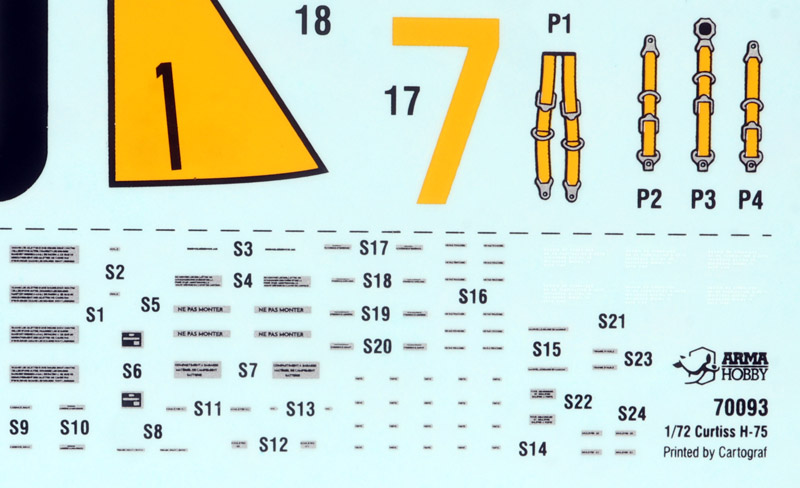
Decals are printed perfectly by Cartograf.
They are luxuriously glossy, colours are well saturated and everything is in perfect register.
Arma Hobby's 1/72 scale Curtiss H-75 A1/A2 is a little gem of a kit with its crisp surface textures, high moulding quality, thoughtful parts breakdown, useful options, colouful marking and high level of detail.
This is a another excellent offering from Arma Hobby.
Thanks to Arma Hobby for the sample
Review Text and Images Copyright © 2025 by Brett Green
Page Created 29 April, 2025
Last updated
17 September, 2026
Back to HyperScale Main Page
Back to Reviews Page |
 Home
| What's New |
Features |
Gallery |
Reviews |
Reference |
Forum |
Search
Home
| What's New |
Features |
Gallery |
Reviews |
Reference |
Forum |
Search