Curtiss P-36C

Arma Hobby, 1/72 scale
S
u m m a r y : |
Description and Item No.: |
Arma Hobby Kit No.70082 - Curtiss P-36C |
Contents and Media: |
75 parts in light grey plastic; seven parts in clear plastic; two 3D printed resin parts; yellow Kabuki die-cut self-adhesive paper masks; decals for three marking options. |
Price: |
€21.36 plus shipping available online at Arma Hobby
£22.99 UK Price (£19.16 Export Price) Plus Shipping at Hannants
and hobby retailers worldwide |
Scale: |
1/72 |
Review Type: |
First Look |
Advantages: |
High quality moulding; gorgeous surface textures and detail; poseable canopy; high quality Cartograf decals. |
Disadvantages: |
Side opening box. |
Recommendation: |
Arma Hobby's 1/72 scale Curtiss P-36C is a little gem of a kit with its crisp surface textures, high moulding quality, thoughtful parts breakdown, useful options and high level of detail. This is a another excellent offering from Arma Hobby.
Highly Recommended. |
Reviewed by Brett Green

The Curtiss P-36C represented the definitive production version of the United States Army Air Corps’ first modern monoplane fighter, a transitional design that bridged the gap between the biplane era and the high-performance fighters of the Second World War. Developed in the mid-1930s, the P-36 emerged from a 1935 USAAC competition that sought a new generation of all-metal fighters with retractable landing gear and enclosed cockpits. Curtiss’ entry proved successful, and the type entered service as the P-36 Hawk.
The P-36C introduced incremental but important improvements over earlier variants, most notably the adoption of the Pratt & Whitney R-1830 Twin Wasp radial engine. This change improved reliability and performance, while also standardising powerplants across several contemporary US aircraft types. Armament was modest by later standards, typically consisting of one .50-calibre and one .30-calibre machine gun in the nose, supplemented in some cases by additional wing-mounted guns.

In service, the P-36C equipped several pursuit squadrons during the late 1930s, a period marked by rapid technological change and growing international tension. Although quickly overshadowed by newer designs such as the Curtiss P-40 Warhawk, the Hawk retained favourable handling characteristics, particularly its manoeuvrability and forgiving nature. These traits made it a useful training and transition aircraft as pilots adapted to faster, more complex machines.
The P-36 saw limited combat use with US forces but found greater operational significance in export and licence-built forms. Variants served with a number of foreign air arms, most notably France, where the Hawk 75 achieved considerable success against German aircraft during the Battle of France in 1940.
Although soon obsolete, the Curtiss P-36C played an important role in the evolution of American fighter design, laying the groundwork for more capable successors while introducing a generation of pilots to the demands of modern aerial combat.
Arma Hobby has added a new family to their ever-growing range, 1/72 scale Curtiss Hawk.
The debut offering in April of this year was the Curtiss Hawk H-75 A-1/A-2. This variant bore the brunt of battle over France in the first year of the war, plus French North Africa up until the Armistice. This was followed by the P-36A.
Arma has now added the Curtiss P-36C to their lineup. This variant is best known for its action over Pearl Harbor on 7 December 1941.
Arma Hobby's 1/72 scale Curtiss P-36C comprises 75 parts in light grey plastic; seven parts in clear plastic, two parts in grey 3d printed parts, yellow Kabuki die-cut self-adhesive paper masks and Cartograf decals for three marking options.
The grey plastic parts are delivered on just two sprues. Moulding quality is excellent. The plastic parts otherwise boast a lovely smooth texture.
Two 3d printed resin parts are included in the box.

These are small aerodynamic fairings under the wings that streamlined covers for the wing gun installations and their associated mechanisms.
Being a long-run kit, the plastic parts are moulded with all the alignment aids that you would expect including pins, holes, slots and tabs.
Moulding quality is excellent.
Some of the sprue attachments are moulded to the surfaces of the kits so take care when cutting these off and cleaning them up.
Surface textures are just gorgeous. Recessed panel lines, raised venbts, circular fastener heads and other structural details are very fine.
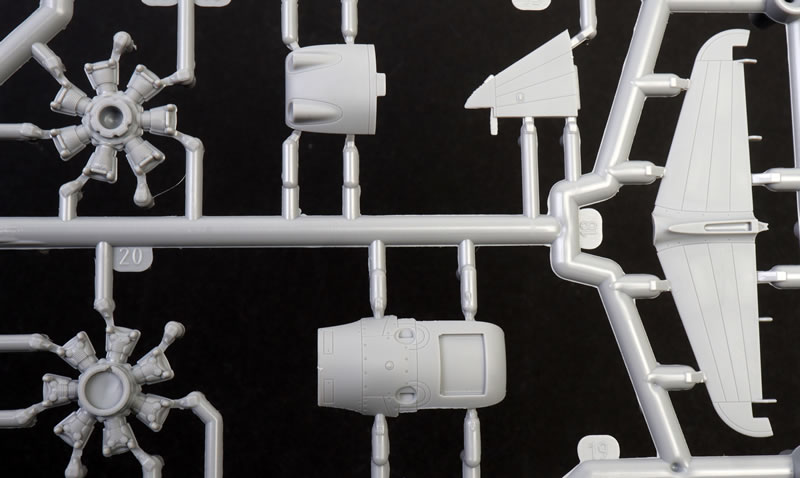
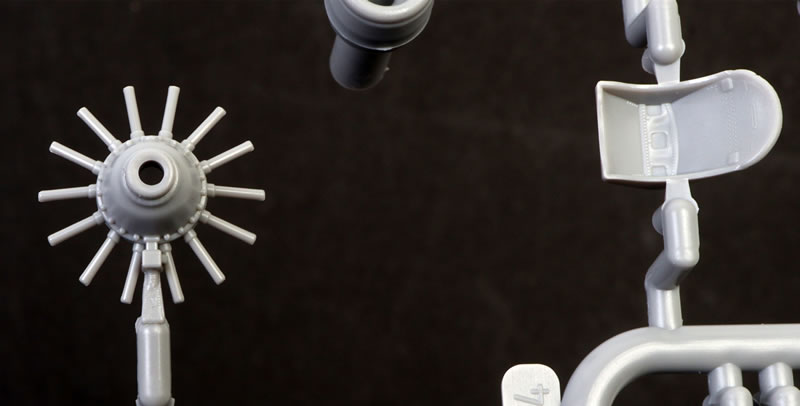
The fuselage is supplied as left and right halves. The engine is simply broken down into three parts but detail is not compromised.
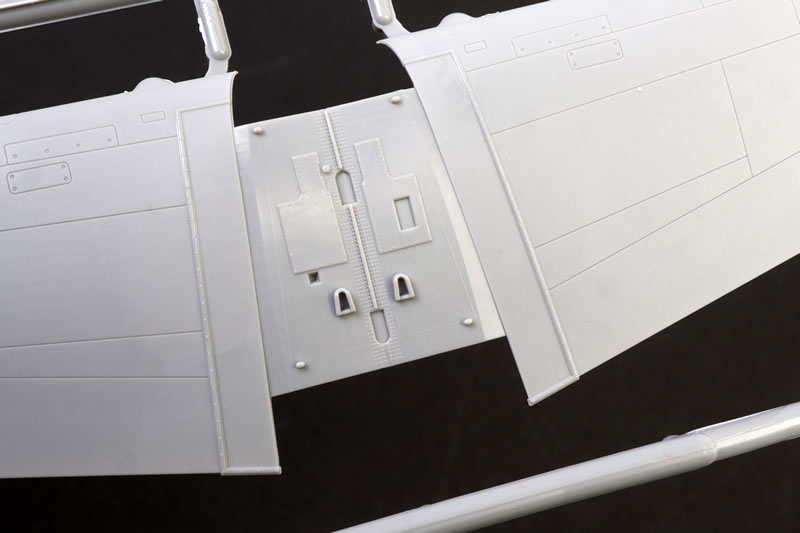
The cockpit floor is moulded as the centre section of the wings.
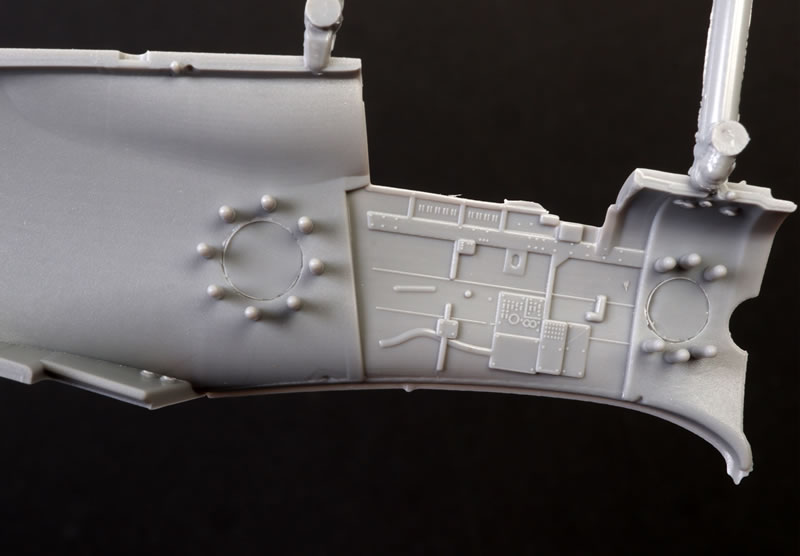
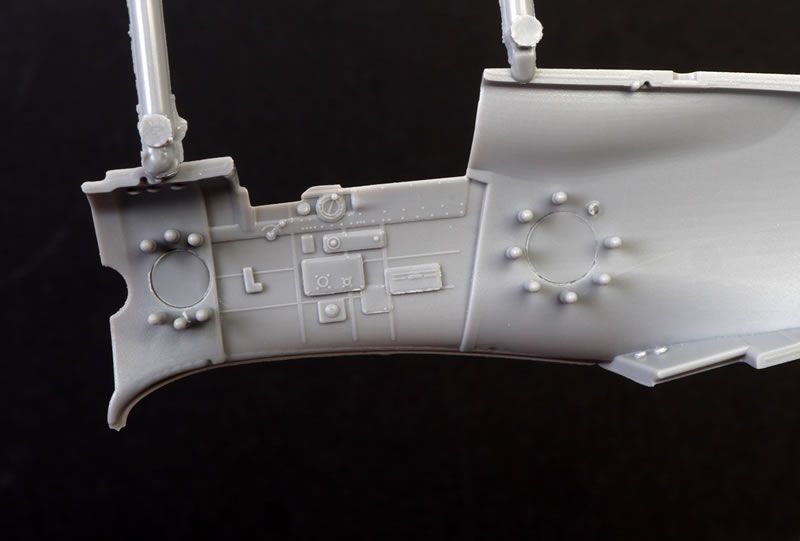
Some cockpit sidewall detail is moulded directly to the inside of the fuselage halves.
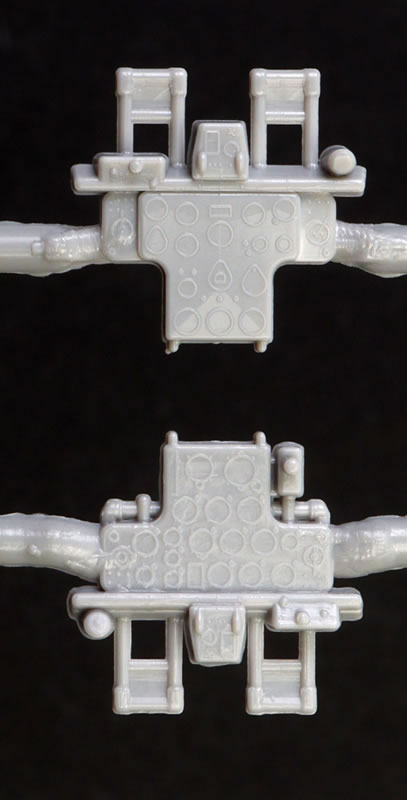
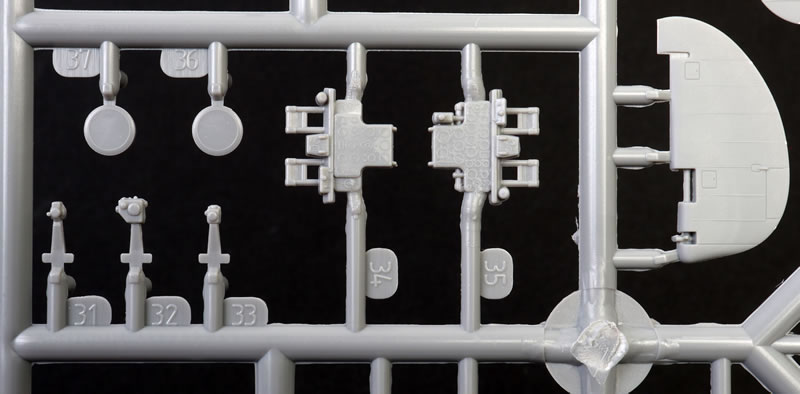
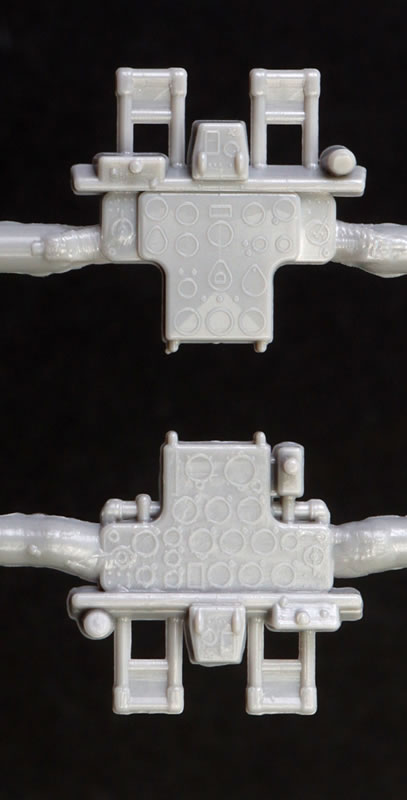
Additional separate parts include, throttle quadrant; instrument panel with a moulded pair of rudder pedals, control column and more.
The instrument panel features raised detail that will respond well to careful dry brushing. Rudder pedals are moulded to the bottom of the panel frame.
As an option, an overlay decal is supplied for the instrument panels and switch panel. Harness strap decals are included as well.
There are some really nice plastic details in the cockpit too.
The wing parts are full span lower and upper halves. They are suitably thin at the trailing edges. Aileron hinge lines are appropriately heavier than the general panel line detailing.
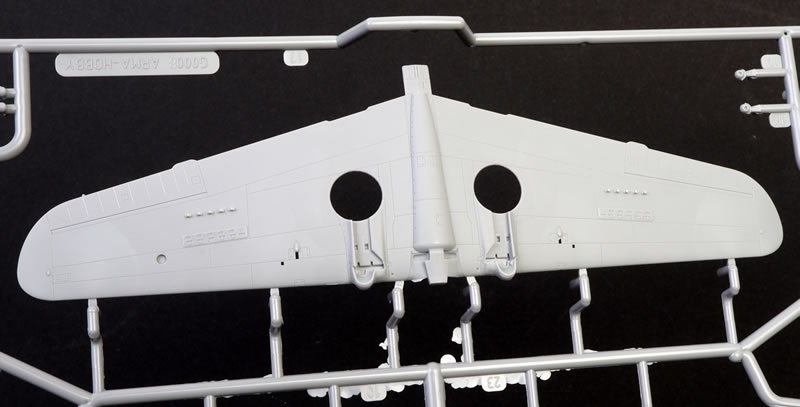
The main wheel wells are nicely detailed. The sidewalls start life as a flat plastic strip scored in three places. The strip is then folded into a box representing the four sides of the wheel wells. I would suggest that you apply a small amount of liquid cement to the folding recesses, but be very careful when folding the parts,. A separate domed ceiling is also supplied for each side.
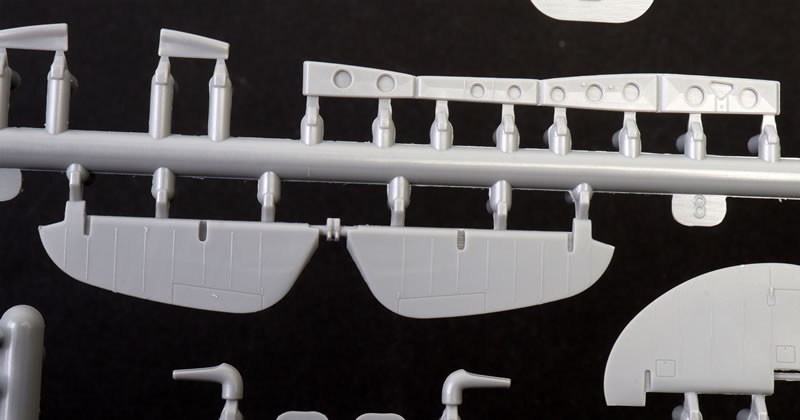
The wheels are subtly bulged and flattened with a fine radial tread.
Elevators and rudder are moulded as separate parts and may be posed to taste.
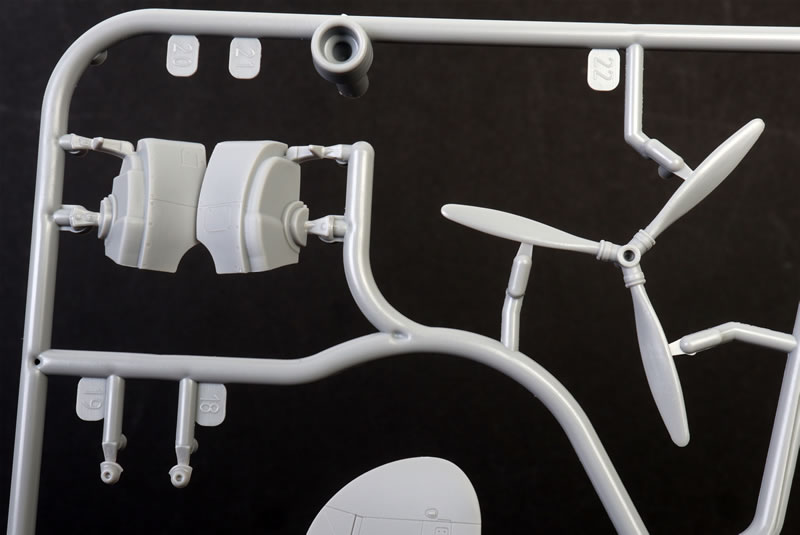
The tail wheel and strut are moulded as a single part. Detail looks fine.
A number of additional parts and unused options are included on the sprues.
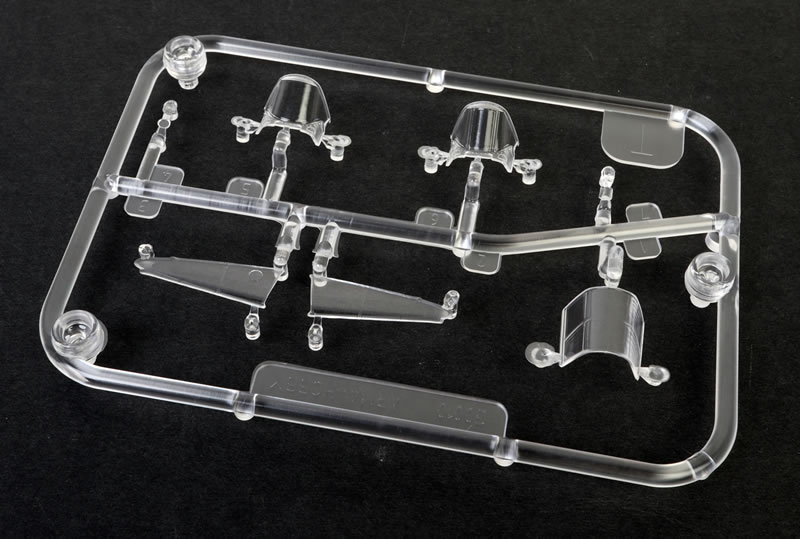
Clear parts are impressively transparent and free from distortion.
Instructions are supplied as an eight page stapled A5-sized booklet.
The kit is packed into a end-opening cardboard box that is a bit flimsy.
Marking Options
The kit decal sheet offers markings for three options:

They are:
-
Curtiss P-36C, 27th Pursuit Squadron, 1st Pursuit Group, National Air Races, Cleveland, Ohio, September 1939 Aircraft finished in one of the most distinctive experimental camouflage schemes used by the 27th PS. The temporary, high-contrast paintwork was intended for display purposes and formed part of trials conducted prior to the introduction of standard wartime camouflage schemes.
Curtiss P-36C, 27th Pursuit Squadron, USAAC, Selfridge Field, Michigan, 1939 Aircraft photographed before the application of display camouflage, finished in the uniform, classic scheme used by frontline units. An example of the early appearance of the P-36C before the intensive camouflage testing phase.
Curtiss P-36C, 23rd Composite Group, Eglin Field, Florida, 1940 Aircraft used for intensive training and test flights. The unit took part in training interception exercises involving B-25B bombers from James H. Doolittle's unit, prior to the Tokyo raid in April 1942. The provisional camouflage and visible wear are the result of frequent flying and repeated repainting.
Stencil markings are printed on the same single sheet, as are propeller logos and wing walk markings.
Decals are printed perfectly by Cartograf.
They are luxuriously glossy, colours are well saturated and everything is in perfect register.
Arma Hobby's 1/72 scale Curtiss P-36Cs another little gem of a kit with its crisp surface textures, high moulding quality, thoughtful parts breakdown, useful options and high level of detail.
This is a another excellent offering from Arma Hobby.
Thanks to Arma Hobby for the sample
Review Text and Images Copyright © 2026 by Brett Green
Page Created 27 March, 2026
Last updated
27 March, 2026
Back to HyperScale Main Page
Back to Reviews Page |
 Home
| What's New |
Features |
Gallery |
Reviews |
Reference |
Forum |
Search
Home
| What's New |
Features |
Gallery |
Reviews |
Reference |
Forum |
Search