Nakajima Ki-84 Hayate Aces
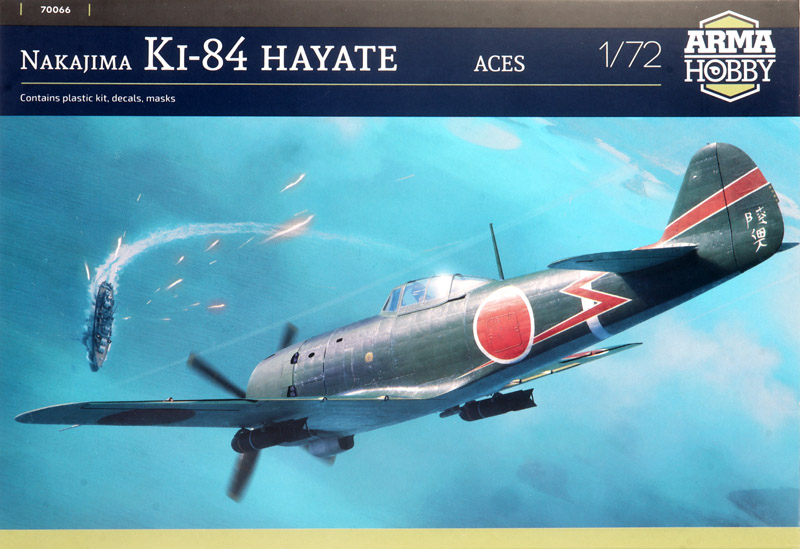
Arma Hobby, 1/72 scale
S
u m m a r y : |
Description and Item No.: |
Arma Hobby Kit No. 70066 - Nakajima Ki-84 Hayate Aces |
Scale: |
1/72 |
Contents and Media: |
66 parts in grey plastic; four parts in clear plastic; self-adhesive masks; decals for two marking options. |
Price: |
€22.12 plus shipping available online at Arma Hobby
£24.99 UK Price (£20.83 Export Price) Plus Shipping at Hannants
and hobby retailers worldwide |
Scale: |
1/72 |
Review Type: |
First Look |
Advantages: |
High quality moulding; excellent surface textures and detail; accurate; many useful options; high quality decals with striking markings. |
Disadvantages: |
End-opening box. |
Recommendation: |
Arma Hobby’s Ki-84 Hayate remains an excellent example of how much detail can be packed into a 1/72 scale fighter model.
First class moulding, restrained surface textures, clever engineering and flexible Ko/Otsu options make this a thoroughly satisfying kit.
The new “Ki-84 Aces” boxing adds two colourful and historically interesting subjects, while the self-adhesive masks provide a useful step up from the basic release.
With excellent fit and finish complemented by crisp Cartograf decals, this is another outstanding Hayate from Arma Hobby and a clear recommendation for fans of the type. |
Reviewed by Brett Green

The Nakajima Ki-84 Hayate (Gale), known to the Allies as “Frank”, was designed to replace the increasingly outclassed Ki-43 Hayabusa. The Japanese Army required a fighter combining high speed and altitude performance with the manoeuvrability, range and heavy armament expected of a modern front-line machine.
Designed by T. Koyama, the resulting low-wing monoplane was powered by an 18-cylinder Nakajima Ha-45 radial and featured a semi-monocoque metal airframe, fabric-covered control surfaces, self-sealing fuel tanks and pilot's armour.
The prototype flew in April 1943 and impressed during trials, although its 624 km/h (388 mph) test speed fell short of the Army's requirement. Nevertheless, the Hayate offered an exceptional combination of speed, climb, manoeuvrability and firepower. The standard Ki-84-I Ko carried two 12.7 mm machine guns in the cowling and two 20 mm cannon in the wings.
The first operational examples appeared in China in August 1944 with the 22nd Sentai. Hayates subsequently fought throughout the Philippines, China and the defence of Japan. Against Allied fighters such as the P-47 Thunderbolt and P-51 Mustang, a well-maintained Ki-84 could be a formidable opponent, with post-war American testing demonstrating exceptional high-altitude speed.
Production reached approximately 3,514 aircraft.
However, deteriorating manufacturing standards, unreliable engines, poor fuel and a shortage of experienced pilots increasingly compromised the aircraft's potential.
Despite these limitations, the Hayate is widely regarded as the finest Japanese Army fighter produced in quantity during the Second World War, its performance demonstrating how formidable Japanese fighter design had become even as the industrial war was being lost.
Arma Hobby launched their all-new 1/72 scale Hayate family with Kit No. 70051 in their Expert Set series in May 2022. The Expert Series includes photo-etched parts, kaubuki yellow paper masks and six marking options. This was followed by the no-frills "Model Kit" boxing of their Ki-84 Hayate with plastic parts and two marking options in mid-2022 and a further Special Attack Squadrons offering in March 2023.
Now Arma has now released a mid-range offering with self-adhesive masks and two marking options with the theme of "Ki-84 Hayate Aces".
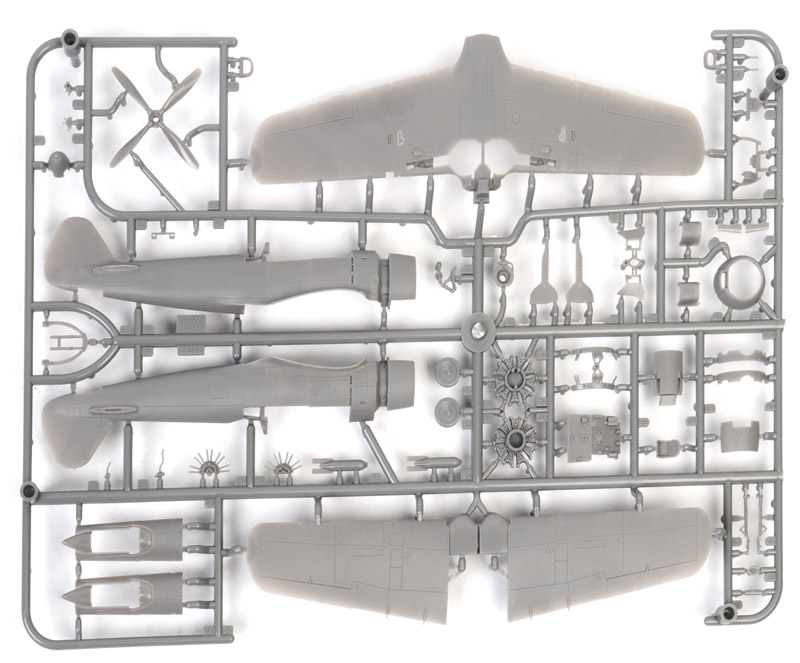
As far as I can tell, the plastic sprues are the same as the earliuer issues. This is a good thing! Optional parts are supplied to allow eiher the Ko or Otsu versions to be built straight from the box.
Arma Hobby's 1/72 scale Nakajima Ki-84 Hayate "Model Kit" comprises 66 parts in grey plastic, four parts in clear plastic, canopy and wheel masks and decals for three marking options.
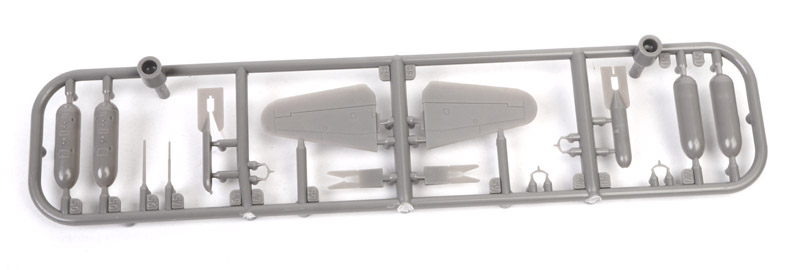
The grey plastic parts are delivered on one large and one small sprues. Moulding quality is excellent with no flaws or visible moulding imperfections on my sample. The plastic parts boast a luxurious satin texture. Arma’s website advises that long-run metal moulds are used for their kit production, and it really does show.
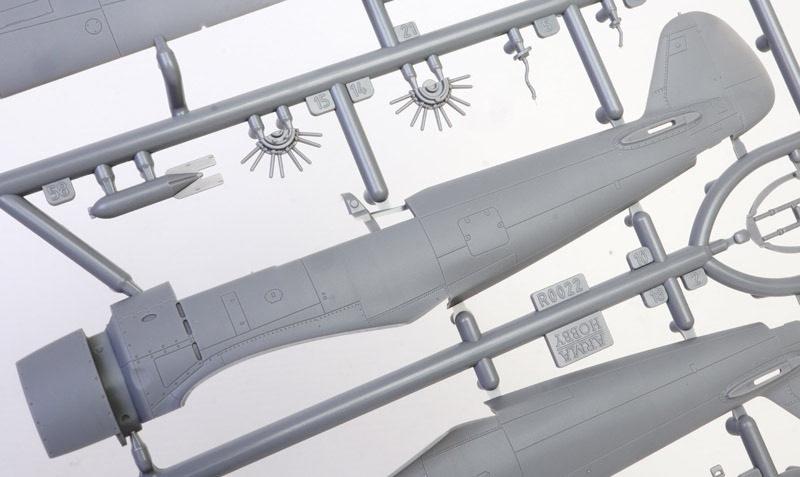
Being a long-run kit, the parts are moulded with all the alignment aids that you would expect including locating pins, holes and tabs.
Surface textures are just gorgeous. Recessed panel lines, circular fastener heads and other structural details are very fine.
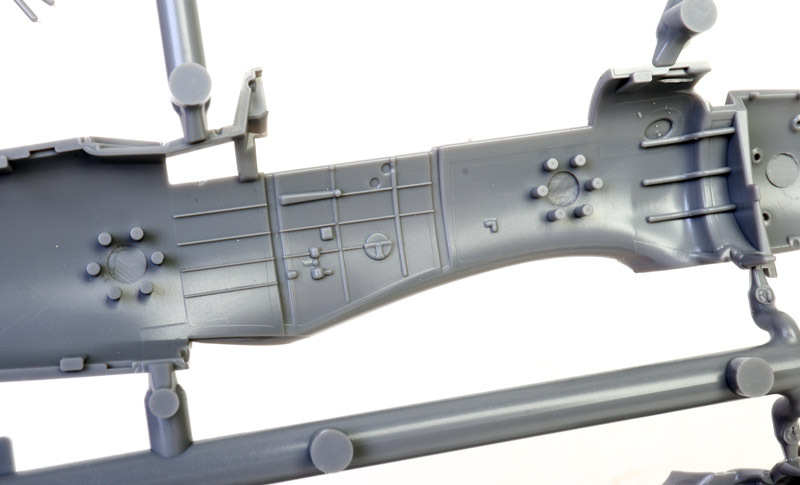
The fuselage is supplied as left and right halves with a few elements that allow some important options.
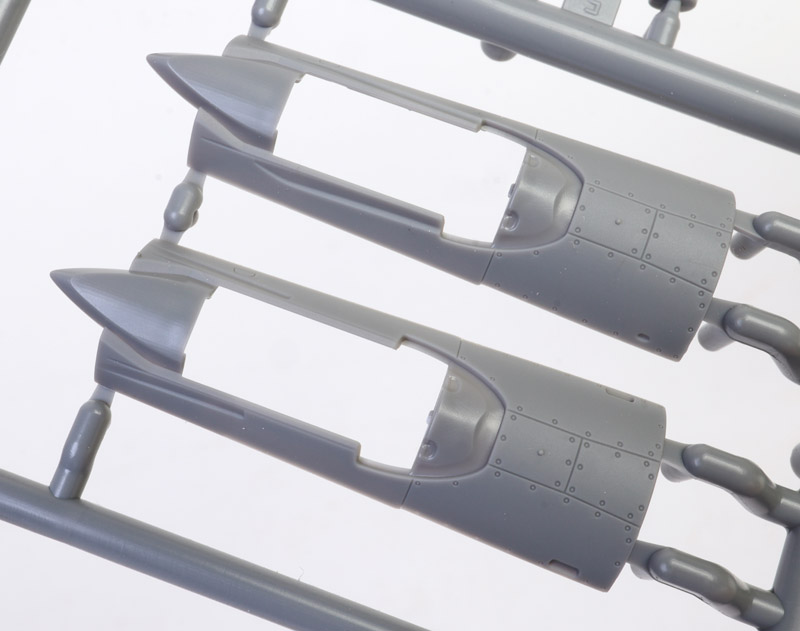
The most obvious is the separate cockpit coaming and mid-upper fuselage insert. Two inserts are included. One insert is designed for a closed canopy. The second insert is designed for an open canopy. It sounds a bit confusing here but the instructions are pretty clear.
Some cockpit sidewall detail is moulded directly to the inside of the fuselage halves. Additional separate parts include a plastic cockpit floor, throttle quadrant; instrument panel, a moulded pair of rudder pedals, control column, radios and more.
The instrument panel and switch panel feature raised detail that will respond well to careful dry brushing, with a decal overlay option also included.
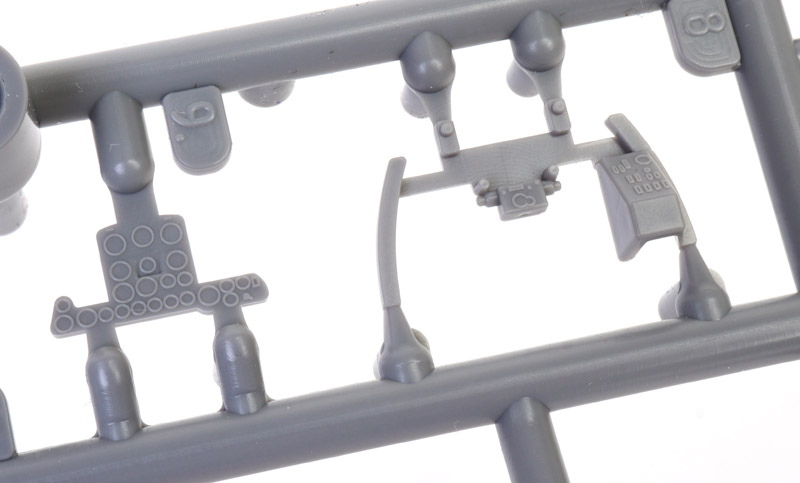
The seat is moulded with six raised circles and arow of raised rivets on the backrest. The real seat was actually perforated, so you may wish to drill out the circles in the seat backrest. Decal harness straps are offered too.
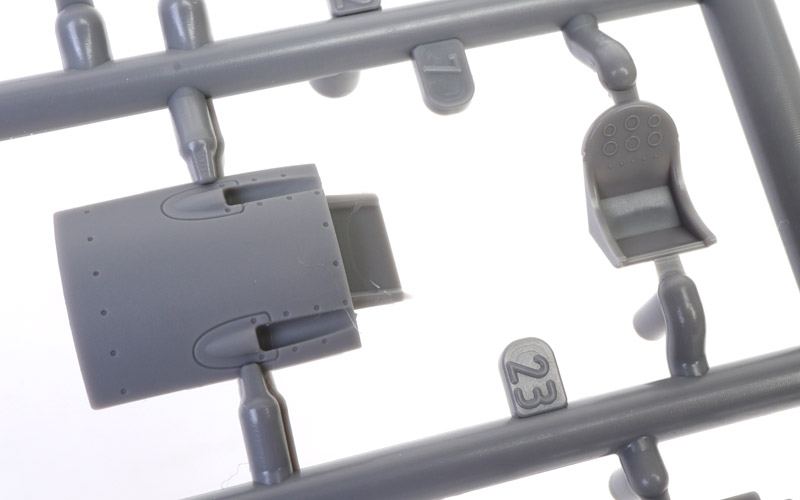
The engine is suitably busy with two rows of cylinders featuring fine cooling fins, upper and lower pushrod halves, exhaust manifolds and crankcase cover.

Alternative lower fuselage intake fairings are offered. Two styles of mesh intake are also included.
The wing parts are full span, top and bottom. They are thin at the trailing edges. I particularly like the very fine and busy recessed rivets and fastener circles on the centre section of the lower wing.

The wheel wells are really nicely detailed between the upper wing halves.

The main wheels are moulded as one piece each and are nicely detailed. Tyre tread is smooth. The wheels are subtly bulged and flattened.
The tail wheel and strut are moulded as a single part. Detail looks good.
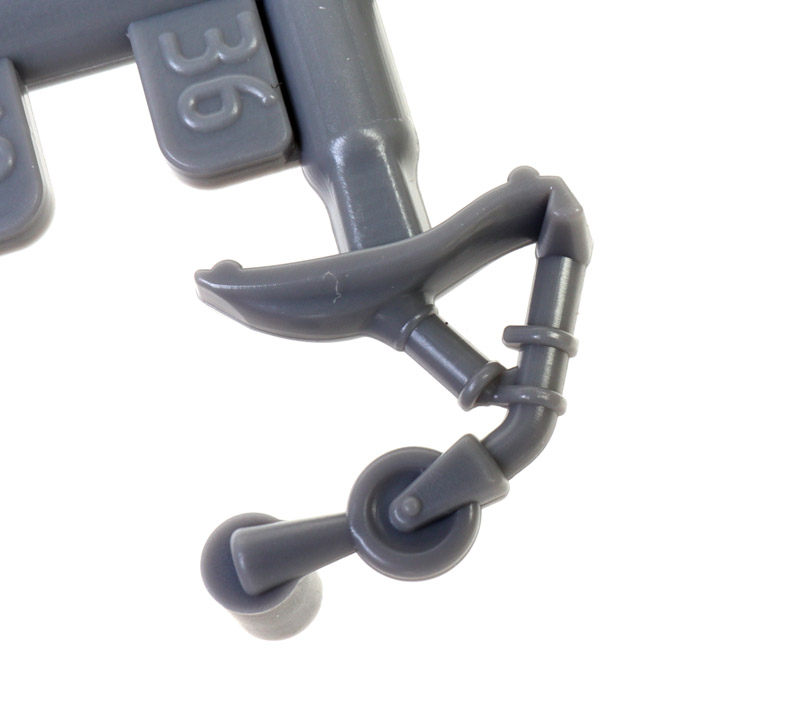
Ordnance includes a pair of drop tanks, 100 kg bombs an a single 250 lb bomb. The bomb offers a finger grip on one pair of the fins to make installation easier. The grip is simply snapped off and cleaned up after the glue sets.
Clever!

The canopy parts are thin and clear.

Instructions are supplied as a eight page stapled A5-sized booklet.
The kit is packed into a end-opening cardboard box. I have to say that I have never been a fan of end-opening boxes - access to the parts is more difficult, loose parts can easily be lost while retrieving instructions or a larger sprue, and the format is less structurally rigid, inviting the contents to be crushed when the box is inevitably at the bottom of a pile of kits.
I know it is a nit-pick but some day I would like to see Arma Hobby releases in a lid-style of box.
Marking Options
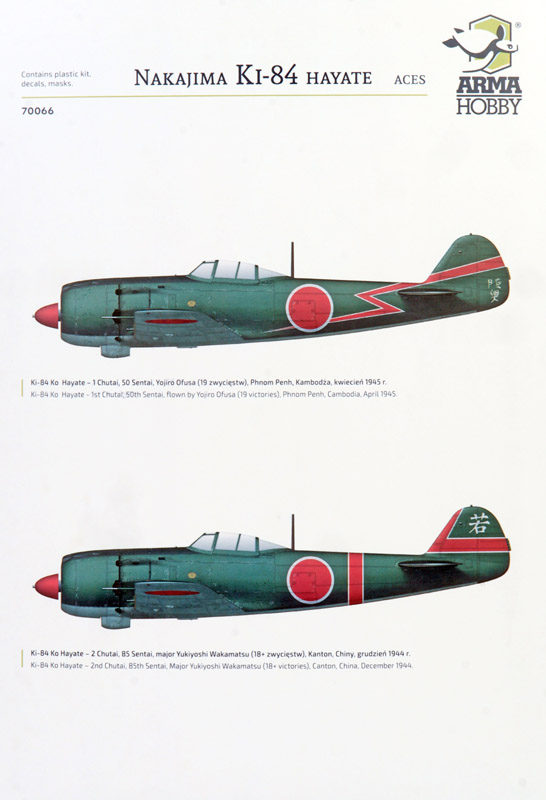
The kit decal sheet offers markings for two marking options.

-
Ki-84 Ko Hayate – 1st Chutai, 50th Sentai - Yojiro Ofusa – 19 victories, Phnom Penh, Cambodia, then part of French Indochina, April 1945. This aircraft was flown by one of the most successful pilots of the 50th Sentai. Its most distinctive feature is the striking red-and-white lightning marking extending along the rear fuselage and tail.
-
Ki-84 Ko Hayate – 2nd Chutai, 85th Sentai - Major Yukiyoshi Wakamatsu – 18 or more victories
Canton, China, December 1944. This aircraft belonged to the commander of the 85th Sentai and one of the leading aces to fly the Hayate. It is distinguished by broad red bands around the fuselage and tail, together with the characteristic marking on the vertical stabiliser.
Stencil markings are printed on the same single sheet, as are propeller logos and wing walk markings. You'll need to paint your own yellow wing leading edges though.
Colour callouts are provided for FS numbers and model paint numbers from a wide variety of companies – Hakata, AK, Mr Paint, AMMO, Mr Collor, Vallejo and Tamiya.
Decals are printed by Cartograf. They are glossy, colours are well saturated and everything is in perfect register.
Arma Hobby’s Ki-84 Hayate remains an excellent example of how much detail can be packed into a 1/72 scale fighter model.
First class moulding, restrained surface textures, clever engineering and flexible Ko/Otsu options make this a thoroughly satisfying kit.
The new “Ki-84 Aces” boxing adds two colourful and historically interesting subjects, while the self-adhesive masks provide a useful step up from the basic release.
With excellent fit and finish complemented by crisp Cartograf decals, this is another outstanding Hayate from Arma Hobby and a clear recommendation for fans of the type.
Thanks to Arma Hobby for the sample
Review Text and Images Copyright © 2026 by Brett Green
Page Created 26 August, 2026
Last updated
27 August, 2026
Back to HyperScale Main Page
Back to Reviews Page |
 Home
| What's New |
Features |
Gallery |
Reviews |
Reference |
Forum |
Search
Home
| What's New |
Features |
Gallery |
Reviews |
Reference |
Forum |
Search