Solomons Air War Volume 1
Guadalcanal
Aug – Sept 1942
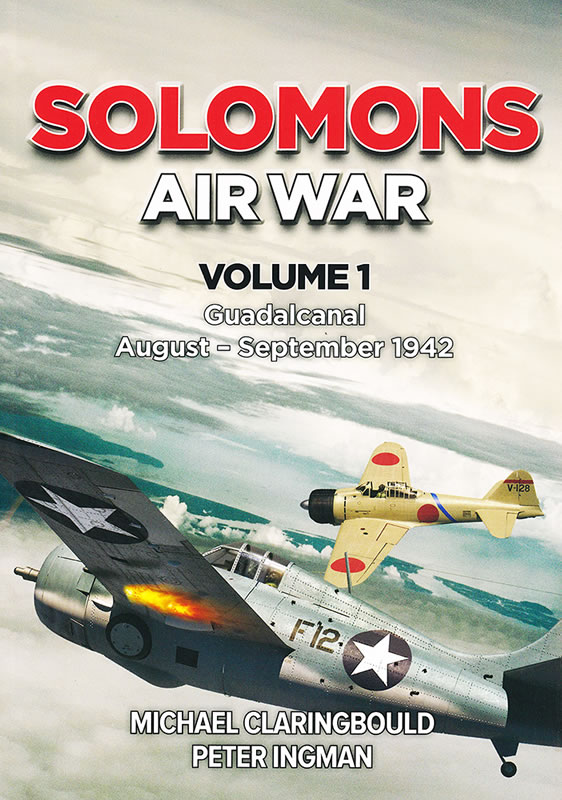
by Michael Claringbould & Peter Ingman
Avonmore Books
S u m m a r y : |
Catalogue Number, Description and ISBN: |
Solomons Air War Volume 1
Guadalcanal August – September 1942
by Michael Claringbould & Peter Ingman
Avonmore Books |
ISBN: |
ISBN 978-0-6452469-3-3 |
Contents & Media: |
248 pages in a soft cover, 25cm x18cm, many historical photographs, maps, colour profiles and aircraft details. |
Price: |
AUD $35.21 normally plus shipping available online from Avonmore Books |
Review Type: |
First Look |
Advantages: |
Detailed and comprehensive look at the air campaign in the Solomon Islands from August to September,1942, with excellent informative text, historical photos and maps, as well as many aircraft profiles. |
Disadvantages: |
None noted. |
Conclusion: |
A great, should have, reference for modellers of all scales interested in the Pacific theatre in early stages of WWII. |
Reviewed by David Couche

Avonmore Books has now launched a new series on the South Pacific theatre of WWII, specialising in military and aviation history.
This volume, “Solomons Air War Volume 1- Guadalcanal August – September 1942” is the first in the new series that chronicles aerial warfare in the opening phase of the war in the Solomons Islands theatre, being the critical period of August-September 1942.
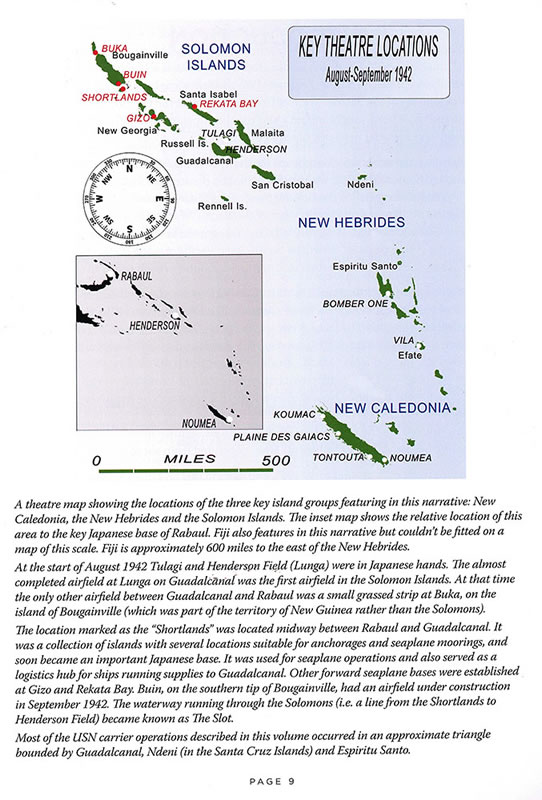
After occupying the Solomon Islands capital of Tulagi with ease in May 1942, the Imperial Japanese Navy commenced building an airfield on the adjacent island of Guadalcanal. The indispensable airfield was over 600 miles distant from their main base of Rabaul and promised to extend the reach of their aircraft into the Allied occupied island chains of Fiji, the New Hebrides and New Caledonia. Much was at stake and the airfield would be held at all costs.
Then, in early August 1942, a bold American invasion of both Tulagi and Guadalcanal caught the IJN completely off guard. Nevertheless, Japanese air power responded swiftly and, in some cases, desperately. So began the knife-edge struggle for Guadalcanal.
An ever-increasing variety and number of IJN units was poured into the struggle, met initially with USN carrier-based Wildcats backed up by SBD Dauntless dive-bombers and the new TBF torpedo bomber. These were soon joined by USAAF fighters operating from the newly operational Henderson Field.
From late August, Japanese carriers entered the fight, adding more complexity to the intense and frenzied air battles. For the first time belligerents are closely matched and the rationale of the IJN's sometimes erratic response is explained. The full extent of both Japanese and US involvement is outlined to a level of detail never before presented.
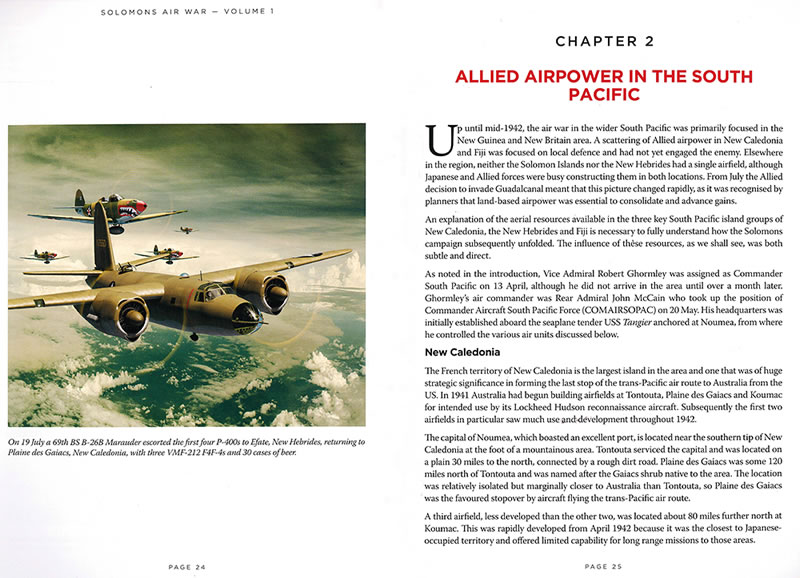
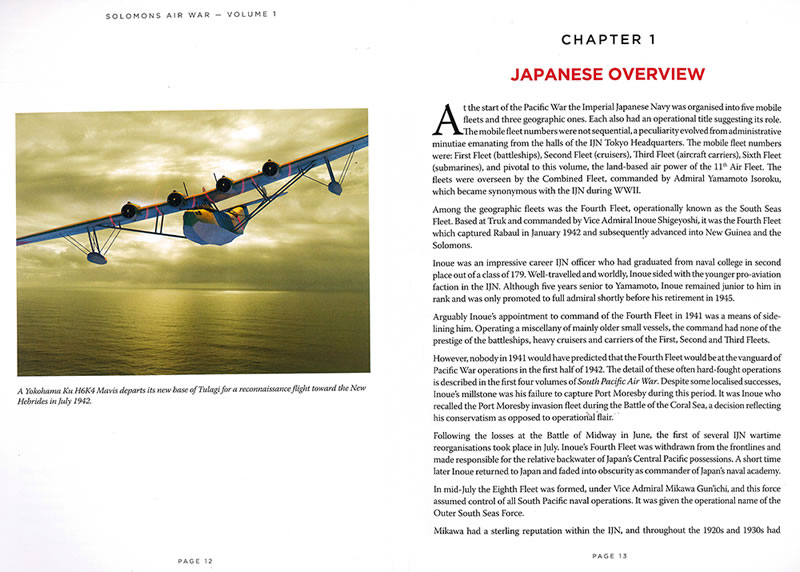
The book consists of 16 chapters that opens with 2 chapters providing an overview of Japanese forces and locations and then the Allied overview as of early August 1942. The text has been written in an informative manner that is extremely easy to read and weaves a good story within it. The following 2 chapters looks at the 7th August when US task forces attacked and landed on both Guadalcanal and Tulagi Islands and the desperate Japanese response, which included many air attacks that were literally a one way trip with little chance of returning safely due to the large distances from their Rabaul bases. The next chapter focuses on a day of torpedo attacks of the US carrier forces by Betty torpedo bombers which ended with a high toll on the Japanese forces. The US carrier Task force 61 then withdrew away from the islands, leaving the US Marines under considerable strain from attacking Japanese forces for a period in August from the 18th to the 23rd August.
What follows in the next chapters is the discovery of a Japanese airstrip that was developed into “Henderson Field” named after Major Lofton Henderson, a Marine SBD pilot killed in the Battle of Midway. This airfield became a major tool in the US development of air power in the Solomon Island for the remainder of the campaign.
The withdraw of Task Force 61 led to the Battle for the Eastern Solomons which happened in 3 sections. This was an air and naval set of battles that raged over the day with many loses for both forces, 25 US and 60 Japanese aircraft. A number of both naval forces also sustained damage. At this stage, the code name for Gaudalcanal was “Cactus” so the air assets, especially at Henderson Field became know as the Cactus Air Force. During the period of the 26th to 31st August, whilst under considerable stress from fighting continually and aircraft losses, Henderson was gradually reinforced with a mix of aircraft, mainly wildcat and Airacobras.
The final chapters of this period cover the “Tokyo Express” where Japanese destroyers, under the cover of darkness, sneaked through the straight and reinforced the island dwindling forces and how the Allies were trying to counteract them. The book finishes off with the Battle of Edson Ridge and the loss of the USS Wasp carrier.
To support the text, are numerous maps and diagrams, explaining visually what was occurring as well as quite a number of historical photographs of both sides through this period at these airfields and of various naval forces.
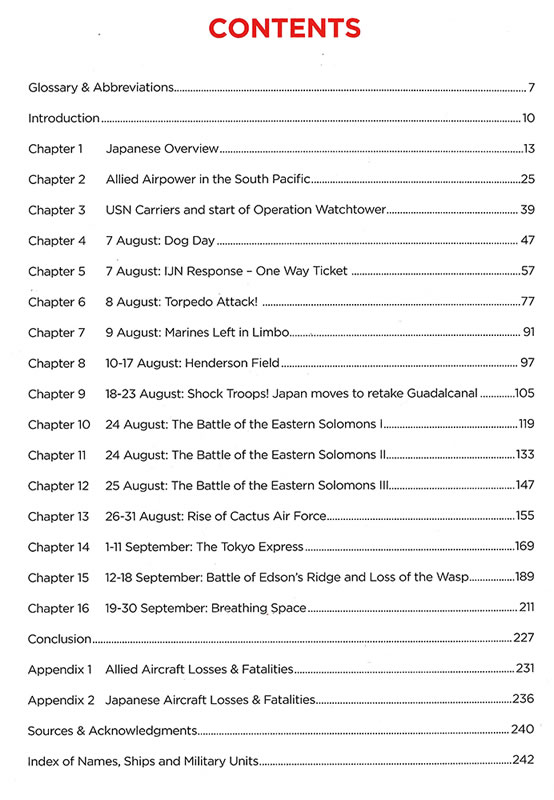
There are several appendices at the end of the book with lists of “Aircraft Losses & Fatalities” for both the Allies and the Japanese. There are a number of side colour profiles of both Japanese and Allied aircraft from different units and times interspersed throughout the book.
This book has been produced for the aviation enthusiast/history buffs, now concentrating on the Solomon Islands theatre of operations involving the Japanese and Allied air units on Guadalcanal and Tulagi islands. After a very interesting read, I look forward to the next instalment. For the modeller there is plenty of colour reference material in profiles etc supplied as well as some good period photographs of aircraft. All in all, this book is a good read and useful for the modeller.
Well recommended.
Many thanks to Avonmore Books for the review sample.
Review Copyright © 2026 by David Couche
This Page Created on 9 June, 2026
Last updated
9 June, 2026
Back to HyperScale Main Page
Back to Reviews Page

|
 Home
| What's New | Features | Gallery | Reviews | Reference | Resource Guides | Forum |
Home
| What's New | Features | Gallery | Reviews | Reference | Resource Guides | Forum | 


